MARIA RESSA is a renowned kick-ass fighter for global press freedom, one of 2 winners of the 2021 Nobel Peace Prize and presently a journalism professor at Columbia U. in Manhattan. In her book “How To Stand Up To A Dictator,” Ressa tells of running the news site Rappler under the autocratic regime of Rodrigo Duterte, a murderous criminal and petty tyrant who served for six years (2016-2022) as president of the Philippines. Ressa eventually was arrested; even sort of knew it was coming. ¶¶ What follows is the transcript of the last half of her appearance Monday on the PBS NewsHour. The interviewer is Amna Nawaz. ¶¶ The parallels between what happened in the Philippines under Duterte and what’s happening now in the U.S. under our own criminal tyrant, DJ Trump, are all too evident. Something I’m feeling more and more, emphasized by Ressa, who is 61, is that there’s no time to lose. There’s no best time to fight a fascistic consolidation of power over the news media, the judiciary, the ideas allowed for discussion. The longer autocratic power sticks around, the stronger it gets, and the more dangerous.
< < < > > >
MARIA RESSA:
Don’t voluntarily give up your rights, right? I mean, again, in — I will give you our example in the Philippines, where the first newspaper gave up — the television station gave up largest — it lost its franchise or license to operate.
And guess what? It never regained it even after the time of Duterte. Little Rappler with, about 100, 120 people, we stood up. And it was difficult. It was frightening, but we’re still here, right? A point in time when I faced over a century in jail, but I’m still here.
And, after 2021, I had lost some of my rights. I wasn’t allowed to travel, for example, but now here I am. I’m in New York City teaching at Columbia University, right? So I guess what I’m saying is, hold the line is the phrase we use, because it’s connected to the rights that you deserve as a citizen.
And if you do not hold the line at this crucial moment — this is the moment when you are strongest — it will only — you will only get weaker over time. And it isn’t just the journalists, because journalists are the front lines in this, but the question is to every single citizen in America.
It’s the question I threw in the book, how to stand up to a dictator. And that question is simple. What are you willing to sacrifice for the truth? Because if you don’t have facts, you cannot — and I have said this over and over since 2016. Without facts, you can’t have truth. Without truth, you can’t have trust. Without these, we have no shared reality.
You can’t solve any problem, let alone existential ones like climate change. You can’t have journalism. You can’t have democracy. And in a system like that, only a dictatorship wins.
AMNA NAWAZ:
Maria, you’re drawing the comparisons here based on your lived experience, of course, but there are folks who will say, look, the U.S. is not the Philippines. Trump is not Duterte. Our democracy is not the same as the one that you lived in.
What do you say to that, the idea that this is somehow immune, our system, from the same things that the Philippines fell prey to?
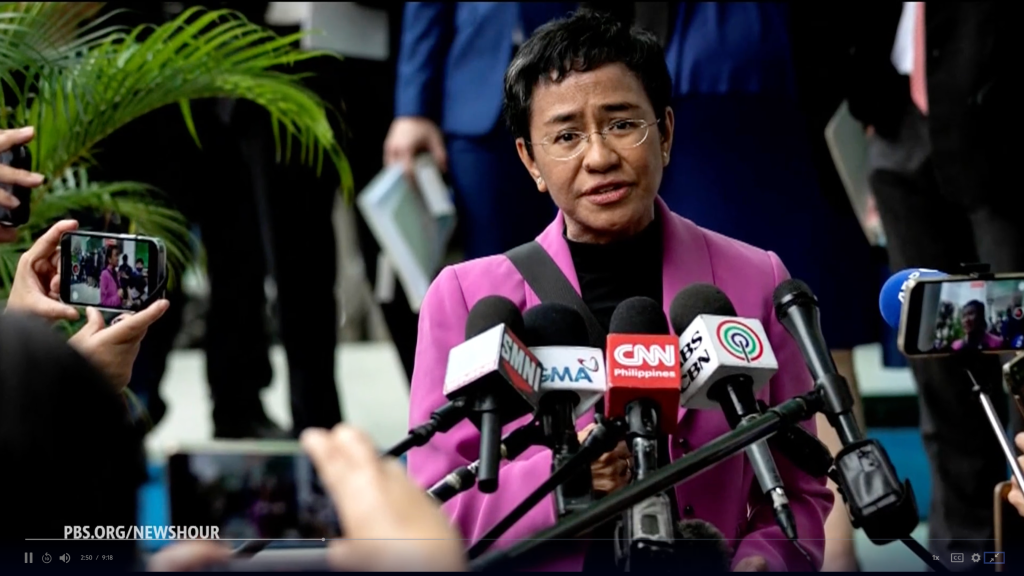
MARIA RESSA:
I think I have two — two ways to respond to that. The first is, it isn’t just the Philippines. There is a dictator’s playbook, and you can look first at Russia, actually, even before that, Turkey, Hungary, Russia, right, with Putin taking office.
And the first step is really to get elected, once you’re elected, to crush the systems of checks and balances, and then replace them with your own — we’re starting to call them the broligarchy, because it’s far more potent, the tech guys are more potent than just normal oligarchies. This is political largess, political patronage.
You have to decide the world you want to live in. You have to decide whether rule of law exists. You cannot normalize impunity. And if you don’t, over time, we normalize that and you lose more and more of your rights.
But here’s a positive note. Rodrigo Duterte’s term ended. He had one six-year term. He did try to extend. And perhaps if the military had supported him, I wouldn’t be here. But we now have another president and those 10 criminal cases that I have had, I have now won eight of those 10 and two left. I still have to ask the Supreme Court for approval to travel, but we’re here.
It’s alarming to see it happening all over again.
AMNA NAWAZ:
We should point out, Maria, that the majority of Americans say they don’t even trust the media right now, that we have seen a decline in that trust over years. And many people like to see the president go after the press in the way that he does. They will hear this conversation and say, good, I’m glad he’s doing what he’s doing. What has the independent press ever done for me?
What would you say to them?
MARIA RESSA:
The role of journalists in a country, in a democracy like the Philippines, like the United States is to hold power to account. and I believe that is why — I mean, you’re not going to have an influencer or a content creator stand up to a dictator. You’re not going to have someone have a set of principles, of standards and ethics that actually pushes against their own self-interest. We’re seeing all of these begin to fall.
But here’s the thing. Part of what triggered that is the technology, the public information ecosystem we live in. Journalists and news organizations have been under attack from the very beginning. So your lack of faith in that is a self-fulfilling prophecy. You lose journalism the way we practice it, you lose democracy.
< < < > > >
Thank you to PBS for these materials. PBS — the PUBLIC Broadcasting System — is a news source owned by all Americans. And being public they are vulnerable, always have been, to political pressures. Trump’s FCC is currently investigating PBS and National Public Radio (related to on-air announcements by underwriters). Its chair has asked Congress to cut their federal funding, which is so tiny relative to the mammoth U.S. budget that it probably wouldn’t be enough to buy really cool T-shirts for Musk’s authorized gang of snoopers into all things Americancitizen.]
 picoalaska