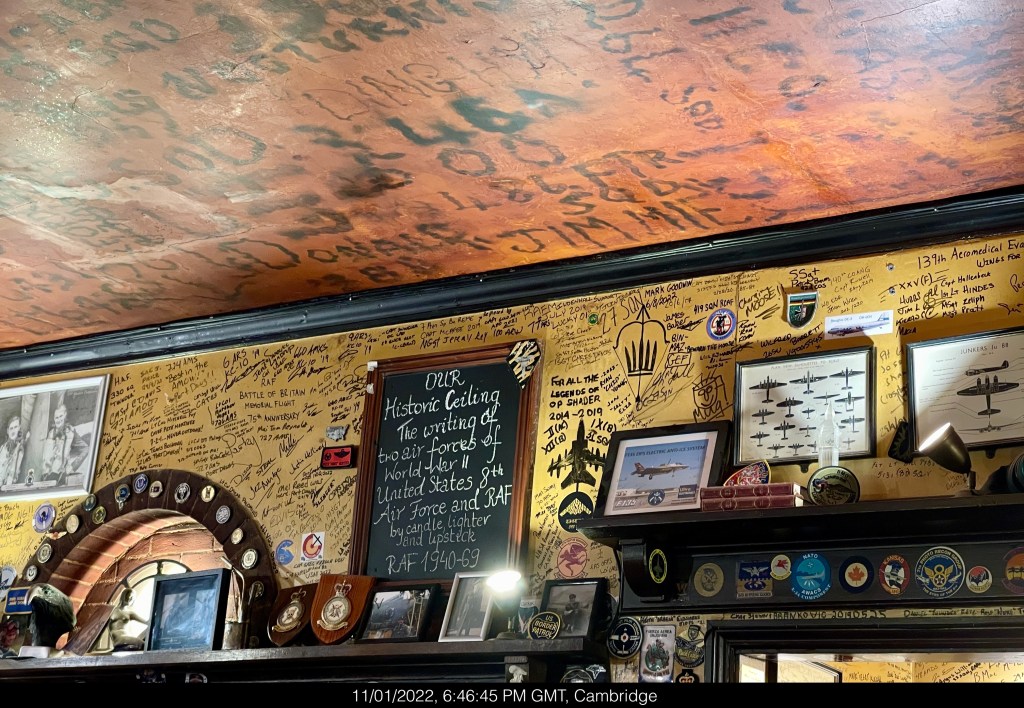
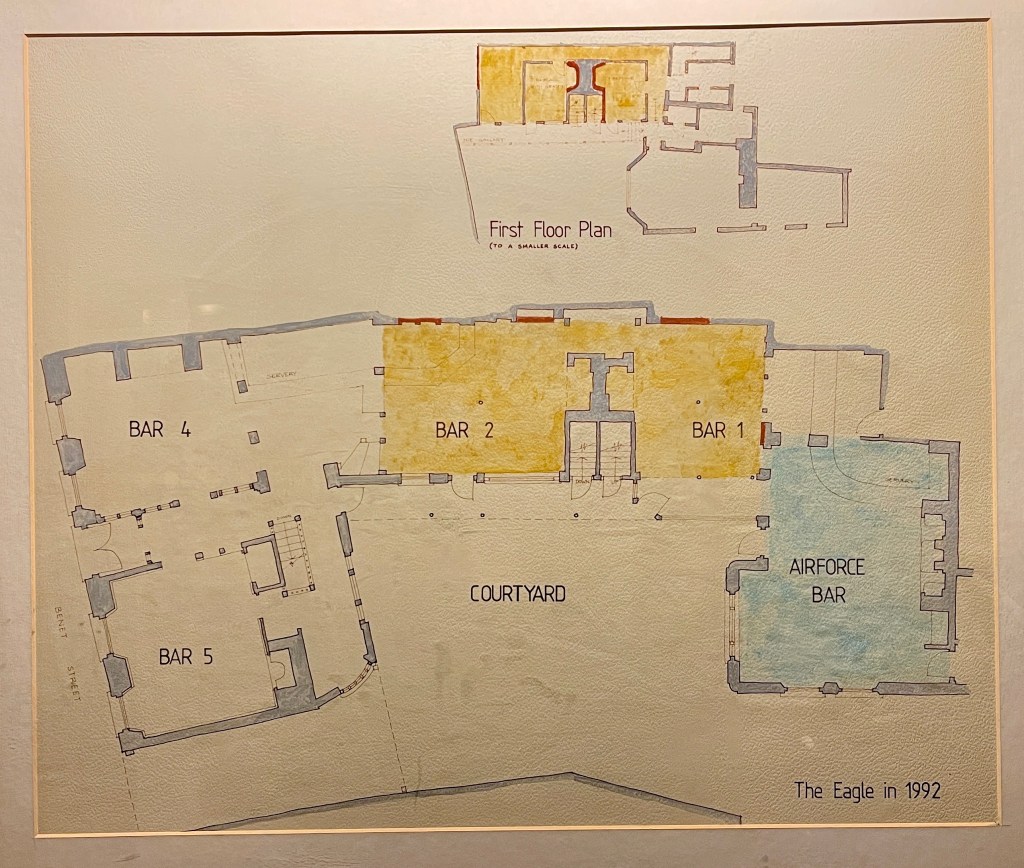
The writing is on the wall at The Eagle, probably the most famous pub in Cambridge, England, a city that just may have more pubs & restaurants per block than anywhere else in the sceptered isle. History is what gives The Eagle its cachet. It claims to date from as far back as 1667, although some sites place its beginnings in the middle ages. We stopped in for dinner and a pint the night we arrived in Cambridge to take in its considerable history. ¶ During WWII, British and American pilots and bomber crews stationed in this part of England (airmen of both nations during the war were quartered over much of Great Britain) would put aside their concerns and their rivalries and drink away an evening at The Eagle. While there, they scrawled their names, the names of their units, their planes, any numbers that meant something to them, on the ceiling. They used (as the sign you can see in the still photo says) candles and lipstick. ¶ Those scrawls remain today. The notation of important data and airmen’s names enjoys a long tradition at the Eagle, and it went on after the war. The walls here, as you will see in these images, are smothered with flyboy graffiti. ¶ Another story told by pub workers and patrons and reiterated in many other places is how, on the evening of February 28, 1953, molecular biologists Francis Crick and James Watson, who were researchers at Cambridge U. and who were said to frequent the Eagle six nights of every seven, stood up in an ale-infused euphoria to announce they’d found “the secret of life” — that is, they had discovered the double-helix structure of the DNA molecule. Some of this is probably an exaggeration. It appears more the case that on that evening Crick came to the pub where he and Watson were regulars to make the announcement to others in their circle. ¶ Another fact regarding the discovery of DNA that is less colorful and certainly less bruited is the part played by a woman scientist, Rosalind Franklin, in giving Watson & Crick invaluable information through her own experiments involving the shape of molecules. She died some years before the two scientists (and a 3rd, Maurice Hugh Frederick Wilkins) won the 1962 Nobel Prize for their discovery.
<<<<<<<< >>>>>>>>
This is my final “Pico Pub Crawl” for the reasons given in my previous post. But it’s not our final visit to old English pubs, which is among our favorite ways to burn time. On Sunday morning we leave for London. ¶ For those following our journey, we changed our plans and now will return to the States in late November. We had plans to visit Normandy and Paris after the U.K. and to end up with 10 days in Prague, but we’re approaching burnout. Also, we got sick. Kathleen and I each came down with a nasty bug as well as conjunctivitis (we tested negative for Covid). We appear to be mostly clear of it now but we’ve lost energy. Still, we’ll try to finish up in a big way — 12 days in London.
 picoalaska