What she learned as a journalist living under a dictator

MARIA RESSA is a renowned kick-ass fighter for global press freedom, one of 2 winners of the 2021 Nobel Peace Prize and presently a journalism professor at Columbia U. in Manhattan. In her book “How To Stand Up To A Dictator,” Ressa tells of running the news site Rappler under the autocratic regime of Rodrigo Duterte, a murderous criminal and petty tyrant who served for six years (2016-2022) as president of the Philippines. Ressa eventually was arrested; even sort of knew it was coming. ¶¶ What follows is the transcript of the last half of her appearance Monday on the PBS NewsHour. The interviewer is Amna Nawaz. ¶¶ The parallels between what happened in the Philippines under Duterte and what’s happening now in the U.S. under our own criminal tyrant, DJ Trump, are all too evident. Something I’m feeling more and more, emphasized by Ressa, who is 61, is that there’s no time to lose. There’s no best time to fight a fascistic consolidation of power over the news media, the judiciary, the ideas allowed for discussion. The longer autocratic power sticks around, the stronger it gets, and the more dangerous.  

< < < > > >

MARIA RESSA:

Don’t voluntarily give up your rights, right? I mean, again, in — I will give you our example in the Philippines, where the first newspaper gave up — the television station gave up largest — it lost its franchise or license to operate.

And guess what? It never regained it even after the time of Duterte. Little Rappler with, about 100, 120 people, we stood up. And it was difficult. It was frightening, but we’re still here, right? A point in time when I faced over a century in jail, but I’m still here.

And, after 2021, I had lost some of my rights. I wasn’t allowed to travel, for example, but now here I am. I’m in New York City teaching at Columbia University, right? So I guess what I’m saying is, hold the line is the phrase we use, because it’s connected to the rights that you deserve as a citizen.

And if you do not hold the line at this crucial moment — this is the moment when you are strongest — it will only — you will only get weaker over time. And it isn’t just the journalists, because journalists are the front lines in this, but the question is to every single citizen in America.

It’s the question I threw in the book, how to stand up to a dictator. And that question is simple. What are you willing to sacrifice for the truth? Because if you don’t have facts, you cannot — and I have said this over and over since 2016. Without facts, you can’t have truth. Without truth, you can’t have trust. Without these, we have no shared reality.

You can’t solve any problem, let alone existential ones like climate change. You can’t have journalism. You can’t have democracy. And in a system like that, only a dictatorship wins.

AMNA NAWAZ:

Maria, you’re drawing the comparisons here based on your lived experience, of course, but there are folks who will say, look, the U.S. is not the Philippines. Trump is not Duterte. Our democracy is not the same as the one that you lived in.

What do you say to that, the idea that this is somehow immune, our system, from the same things that the Philippines fell prey to?

MARIA RESSA:

I think I have two — two ways to respond to that. The first is, it isn’t just the Philippines. There is a dictator’s playbook, and you can look first at Russia, actually, even before that, Turkey, Hungary, Russia, right, with Putin taking office.

And the first step is really to get elected, once you’re elected, to crush the systems of checks and balances, and then replace them with your own — we’re starting to call them the broligarchy, because it’s far more potent, the tech guys are more potent than just normal oligarchies. This is political largess, political patronage.

You have to decide the world you want to live in. You have to decide whether rule of law exists. You cannot normalize impunity. And if you don’t, over time, we normalize that and you lose more and more of your rights.

But here’s a positive note. Rodrigo Duterte’s term ended. He had one six-year term. He did try to extend. And perhaps if the military had supported him, I wouldn’t be here. But we now have another president and those 10 criminal cases that I have had, I have now won eight of those 10 and two left. I still have to ask the Supreme Court for approval to travel, but we’re here.

It’s alarming to see it happening all over again.

AMNA NAWAZ:

We should point out, Maria, that the majority of Americans say they don’t even trust the media right now, that we have seen a decline in that trust over years. And many people like to see the president go after the press in the way that he does. They will hear this conversation and say, good, I’m glad he’s doing what he’s doing. What has the independent press ever done for me?

What would you say to them?

MARIA RESSA:

The role of journalists in a country, in a democracy like the Philippines, like the United States is to hold power to account. and I believe that is why — I mean, you’re not going to have an influencer or a content creator stand up to a dictator. You’re not going to have someone have a set of principles, of standards and ethics that actually pushes against their own self-interest. We’re seeing all of these begin to fall.

But here’s the thing. Part of what triggered that is the technology, the public information ecosystem we live in. Journalists and news organizations have been under attack from the very beginning. So your lack of faith in that is a self-fulfilling prophecy. You lose journalism the way we practice it, you lose democracy.

< < < > > >

Thank you to PBS for these materials. PBS — the PUBLIC Broadcasting System — is a news source owned by all Americans. And being public they are vulnerable, always have been, to political pressures. Trump’s FCC is currently investigating PBS and National Public Radio (related to on-air announcements by underwriters). Its chair has asked Congress to cut their federal funding, which is so tiny relative to the mammoth U.S. budget that it probably wouldn’t be enough to buy really cool T-shirts for Musk’s authorized gang of snoopers into all things Americancitizen.]
Keeping the English Sober

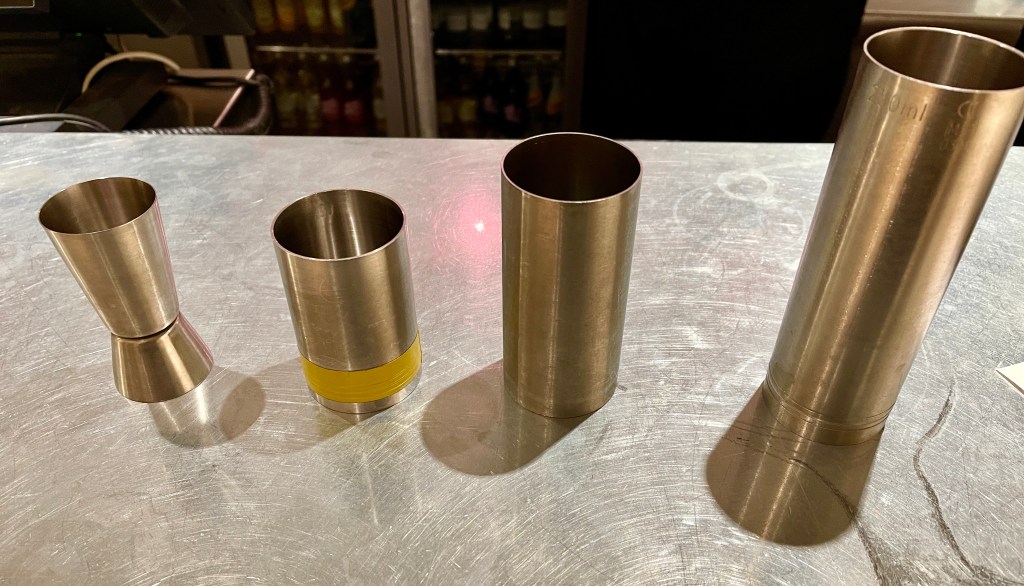
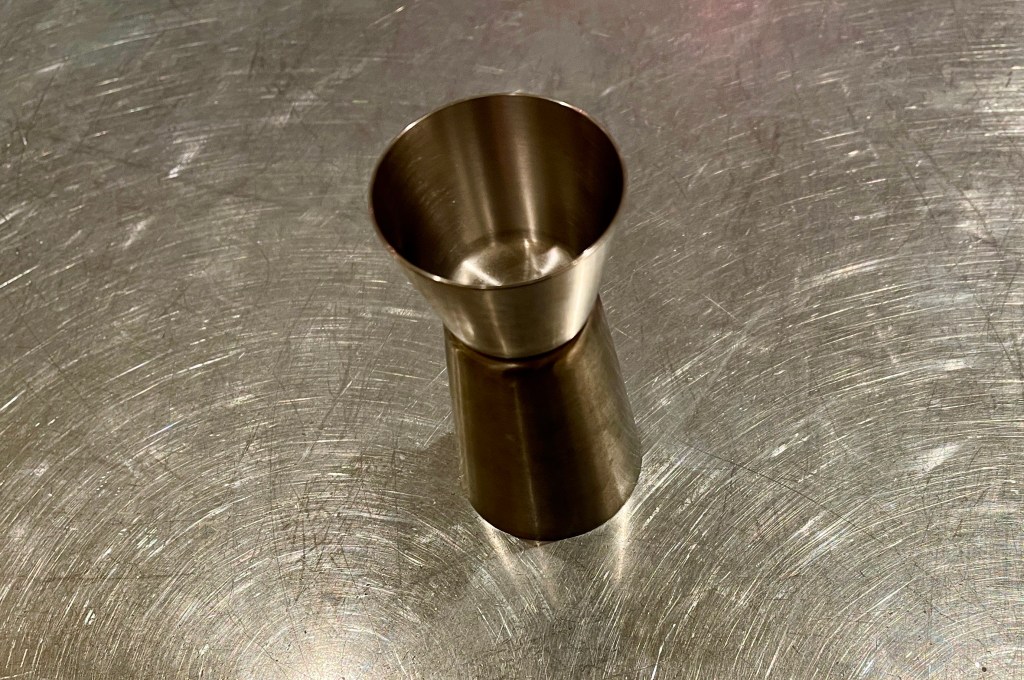
Measure for measure, the English people may be among the most disciplined drinkers on earth. Bartenders are required by law (and by their bosses and bar owners) to dispense certain types of alcoholic beverages in precise amounts, what the law calls “specified quantities,” when serving by the glass. So, for example, when you order still wine at the bar or at table, you’ll likely be offered a choice of small, medium or large. Those sizes correspond to 125 ml, 175 ml and 250 ml (roughly 4¼, 6 and 8½ fluid oz.). At a theatre bar where we recently drank, the barkeep would dole out those amounts in, respectively, the 2nd, 3rd and 4th measuring cups seen in the photo. The 1st cup is for measuring certain spirits — gin, rum, vodka & whiskey. With this end up, as seen in the photo, you can measure out 50 ml. (roughly 1¾ oz.), or what officially amounts to a double shot. Turn the cup over — as in the photo below — and you have the means to pour a single shot, 25 ml. ¶ I’m not certain, but I believe that Irish bars may have to dispense with their beverages under similar guidelines. I wondered, when we were in Ireland and later during our first travels through England, why the drinks uniformly seemed pallid. I seriously wondered, for example, if the gin was being watered down (the Negronis I ordered one evening at a wonderful oyster bar in Galway were frankly of no consequence whatever, and I departed an unhappy patron). But now I think I understand: When ordering certain cocktails, you’ll probably want to make it a double shot and, depending on your taste, budget and tolerance, perhaps order more than one.

A cup for measuring out an exact shot of gin, rum, vodka or whiskey as defined by alcohol-beverage regulations in the U.K., according to a bartender in Cambridge, England. Turn the cup over and you can pour an exact double.

What about American bars & restaurants — what limitations determine the amounts they pour into wine and cocktail glasses? I have not researched this — that is, whether a certain set of regulations governs the quantity you’ll receive when ordering a drink in the States. But my experience tells me it’s entirely up to the bartender. If they’re friendly, if they like you, you’ll get a generous pour. Or buy that second glass of wine. I have often noticed that the second pour is larger than the first. Perhaps it’s a reward for opening your wallet a bit wider.

Pico Pub Crawl — The Eagle, Cambridge, England

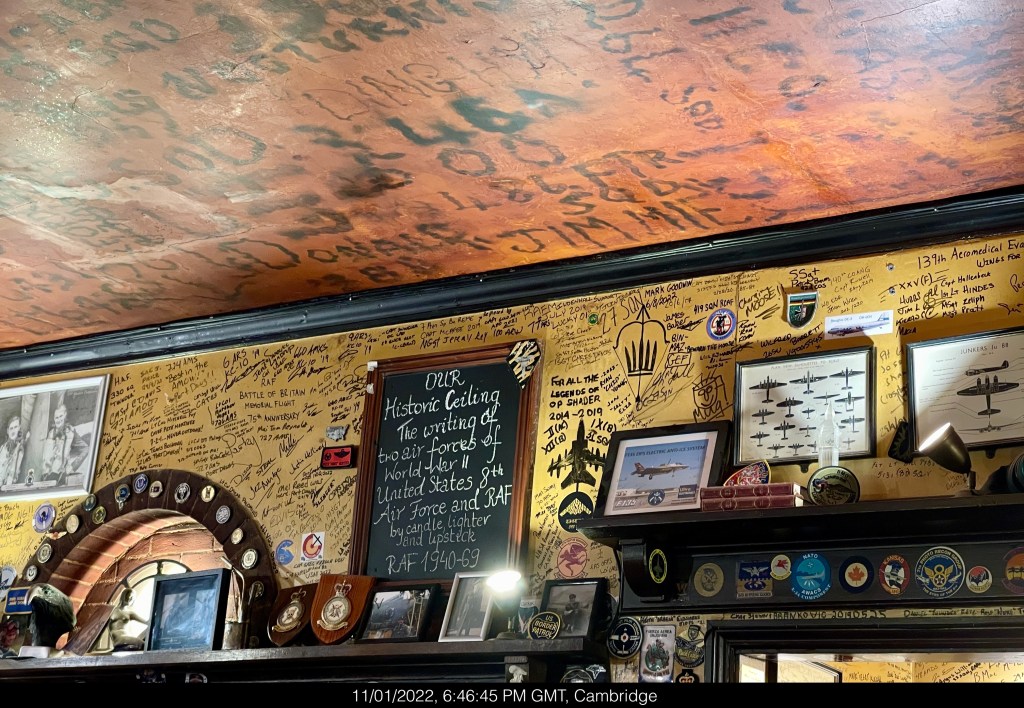
The writing is on the wall at The Eagle, probably the most famous pub in Cambridge, England, a city that just may have more pubs & restaurants per block than anywhere else in the sceptered isle. History is what gives The Eagle its cachet. It claims to date from as far back as 1667, although some sites place its beginnings in the middle ages. We stopped in for dinner and a pint the night we arrived in Cambridge to take in its considerable history. ¶ During WWII, British and American pilots and bomber crews stationed in this part of England (airmen of both nations during the war were quartered over much of Great Britain) would put aside their concerns and their rivalries and drink away an evening at The Eagle. While there, they scrawled their names, the names of their units, their planes, any numbers that meant something to them, on the ceiling. They used (as the sign you can see in the still photo says) candles and lipstick. ¶ Those scrawls remain today. The notation of important data and airmen’s names enjoys a long tradition at the Eagle, and it went on after the war. The walls here, as you will see in these images, are smothered with flyboy graffiti. ¶ Another story told by pub workers and patrons and reiterated in many other places is how, on the evening of February 28, 1953, molecular biologists Francis Crick and James Watson, who were researchers at Cambridge U. and who were said to frequent the Eagle six nights of every seven, stood up in an ale-infused euphoria to announce they’d found “the secret of life” — that is, they had discovered the double-helix structure of the DNA molecule. Some of this is probably an exaggeration. It appears more the case that on that evening Crick came to the pub where he and Watson were regulars to make the announcement to others in their circle. ¶ Another fact regarding the discovery of DNA that is less colorful and certainly less bruited is the part played by a woman scientist, Rosalind Franklin, in giving Watson & Crick invaluable information through her own experiments involving the shape of molecules.  She died some years before the two scientists (and a 3rd, Maurice Hugh Frederick Wilkins) won the 1962 Nobel Prize for their discovery.

Part of the ceiling and a wall in “the RAF bar,” one of the five bars at The Eagle, perhaps the most famous pub in Cambridge, England. (Pub’s floor plan in next photo.)
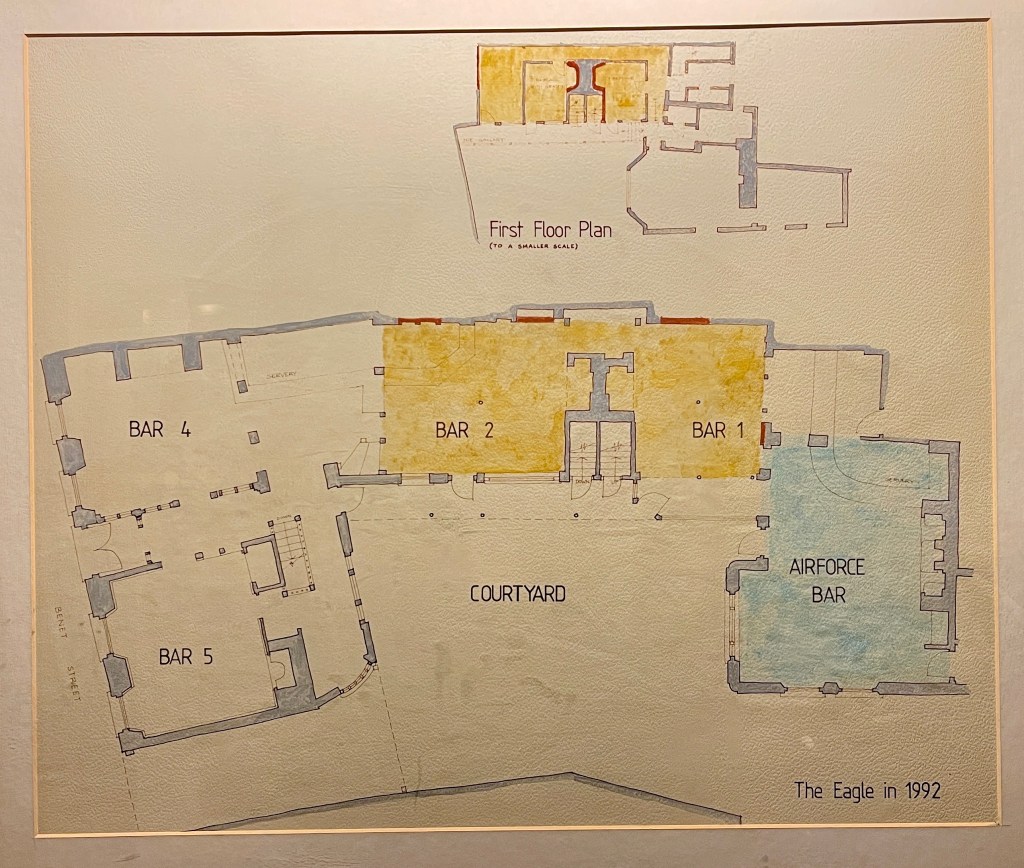
A 1992 drawing of The Eagle’s floor plan hangs on a passageway wall at the pub.

<<<<<<<< >>>>>>>>

This is my final “Pico Pub Crawl” for the reasons given in my previous post. But it’s not our final visit to old English pubs, which is among our favorite ways to burn time. On Sunday morning we leave for London. ¶ For those following our journey, we changed our plans and now will return to the States in late November. We had plans to visit Normandy and Paris after the U.K. and to end up with 10 days in Prague, but we’re approaching burnout. Also, we got sick. Kathleen and I each came down with a nasty bug as well as conjunctivitis (we tested negative for Covid). We appear to be mostly clear of it now but we’ve lost energy. Still, we’ll try to finish up in a big way — 12 days in London.

Pico Pub Crawl — The Turf Tavern, Oxford, England

This is a late October look at the The Turf, a famous hole-in-the-wall pub in Oxford, England, a town where the city is synonymous with the university. The Turf Tavern is ensconced in a hidden byway of what I think is one of the university’s colleges, or maybe nestled between two colleges. I’m not sure. But it’s such a meme to actually locate the pub that I saw T-shirts with a slogan something like “I found The Turf!” ¶ I have made these “pub crawl” videos for several reasons: a) because I love Irish and English pubs of strong and distinctive character, a look & feel that have carried forward, in some cases, for centuries; b) because eating & drinking at these establishments is a pleasureable and relatively inexpensive way to get our calories, and so they’ve become a necessary and enjoyable part of this journey, thus part of what I’m showing through this blog; c) because part of living in Anchorage, Alaska, is to know I’ll never see anything like this there, so I’m having the experience of patronizing such a place more than once — many times more than once if I can stand to look at these videos again. ¶ Which brings up a problem with them: Those who’ve looked at the two I’ve posted so far and now at a third will notice that they’re repetitive. People — workers and patrons — are certainly active but they don’t have an unlimited repertoire of activities. So the charm is wearing off. You can do only so much with a camera held at your belt buckle as you walk about a well-occupied venue without trying to attract attention. Therefore, the next “pub crawl” video I post will be the last, at least until I find something new to do with them. But the next one will be a nearly 2-minute glimpse through an absolutely fantastic pub, with a fantastic history.

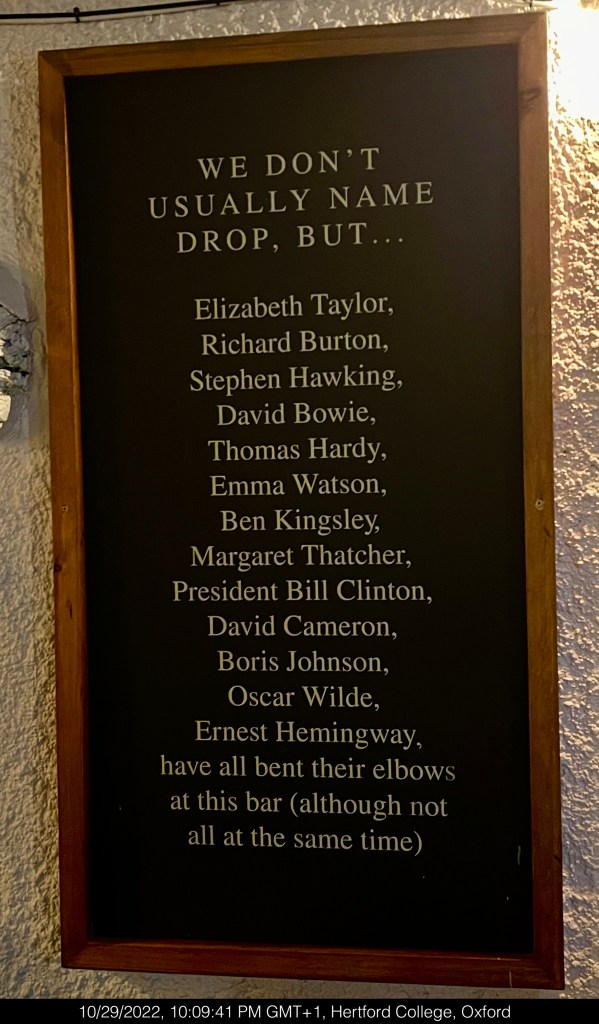
This board hangs along one of The Turf’s passageways & outdoor eating alcoves.

Pico Pub Crawl — The Celt, Dublin

This is the inside of a Dublin pub called The Celt, shown on a Sunday evening in early October. (The first pub in which I walked around w/ my phone/camera leading the way is The Front Door in Galway City.) The Celt is located on Talbot Street in a district north of the River Liffey. Talbot needs some introduction. Although it is a calm and fairly dignified commercial and residential street today, it’s said to have been a boundary of the infamous Monto, Dublin’s red-light district and the largest in Europe during its 19th-20th-century prime. British soldiers were the johns in many cases, so when Ireland won its independence from Britiain in 1921 and set up the Irish Free State in 1922 (that is, for all but the six counties of Ulster Province in the north), the soldiers went home and the chief industry of the Monto district declined. ¶ But when it was going strong, it was notorious for disease and filth and poverty. In James Joyce’s novel “UIysses,” the two protagonists, Leopold Bloom and Stephen Daedalus, visit a brothel in the Monto, but that whorehouse is nowhere as shabby as the more typical brothel apparently was. ¶ We visted the Celt more than once. The energy to be seen in this brief video is mild compared with how electric the place can be. ¶ The second video in this post (below) gives a sample of the live music heard every night.

Irish Stew

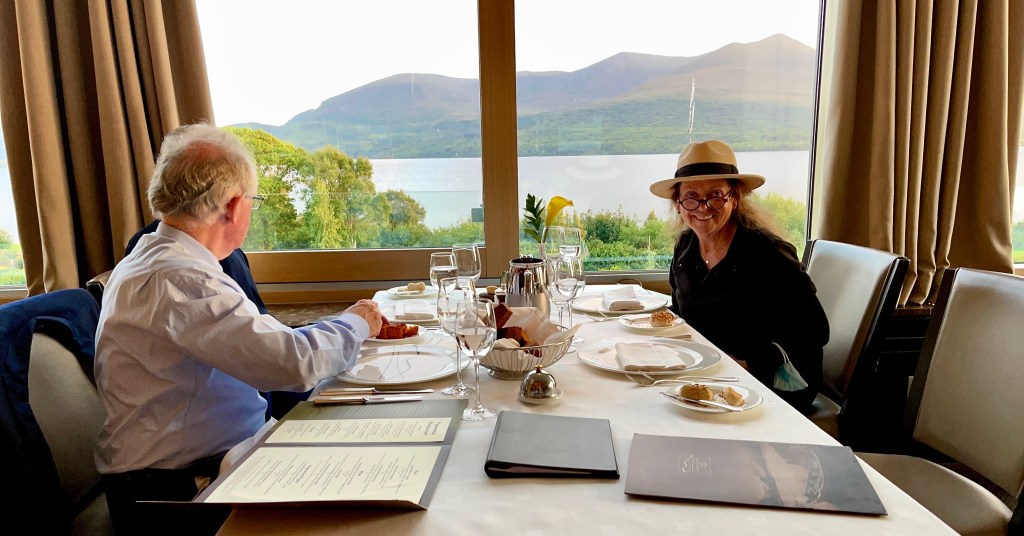
On September 24, towards the end of our first week in Ireland, we celebrated Kathleen’s 70th birthday with a fabulous dinner at the Panorama restaurant in the Hotel Europe outside the city of Killarney, County Kerry. Kathleen and I both had the Dingle Goat Cheese Ravioli, which was one of the most delicious restaurant dishes we’ve ever tasted. It came in a cheese “foam” with roast butternut squash, candied walnuts, pickled shallot, and crisp kale. Altogether four of us marked her birthday, including Kathleen’s brother, Kevin, and their Irish cousin Maurice, whom they met for the first time only 2 days earlier. At dinner we all 4 shared a bowl of buttered new potatoes (which were a creamy nirvana) and a bowl of mixed vegetables. The experience was off the charts. Out beyond the window is Lough (“Lake”) Leane.

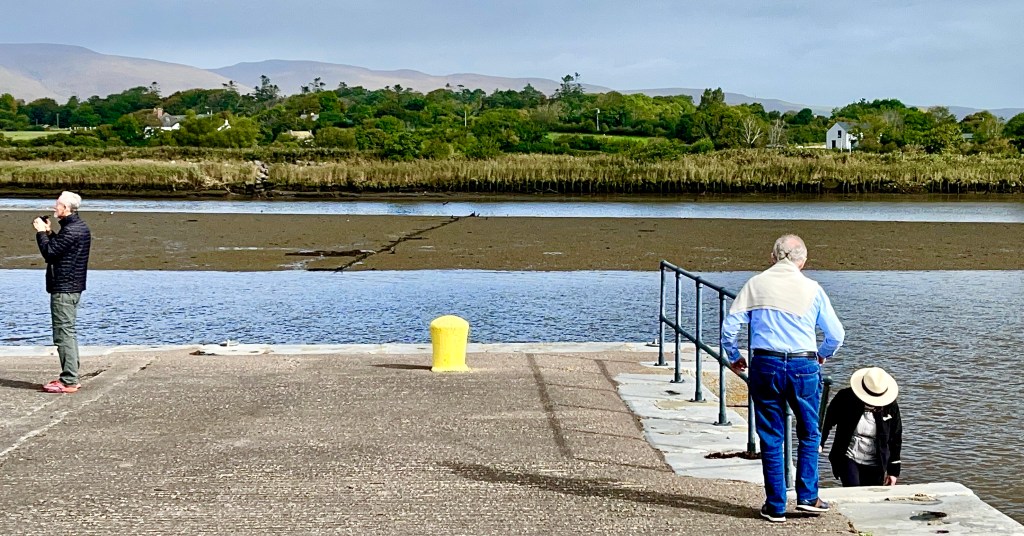
The plot was thick. A German ship, the Aud, carrying weapons intended for Irish revolutionaries, was headed for the west coast of Ireland on the night of Good Friday, 1916, awaiting a signal. Four members of the Irish Volunteers were driving through Killorglin in County Kerry that night on their way to Cahirciveen to seize the wireless station at Valentia Island. According to the Irish Times, they intended to transmit “a series of false signals which would fool the [British] Royal Navy into believing that a German attack on Scottish naval bases was imminent. It was hoped that such a move would allow the Aud … to proceed unmolested through Irish waters.” ¶ But the car’s driver took a wrong turn and drove down a road that ended at this pier at the River Laune. Under pains of poor visibility because the car lacked a headlamp, driver Tommy McInerney saw too late that the vehicle was headed for the water. In it plunged. McInerney survived, but the others drowned, the first casualties of the Easter 1916 Rising. The Aud’s skipper scuttled the ship and its weaponry went down with it. The Irish Revolution was stillborn that Spring, and the Irish were forced to wait several more years before winning independence. ¶ At Ballykissane Pier is a monument to the martyrs. When we were there, I felt that the real monument was this very pier, a concrete and stone structure that I doubt has changed much in 106 years.

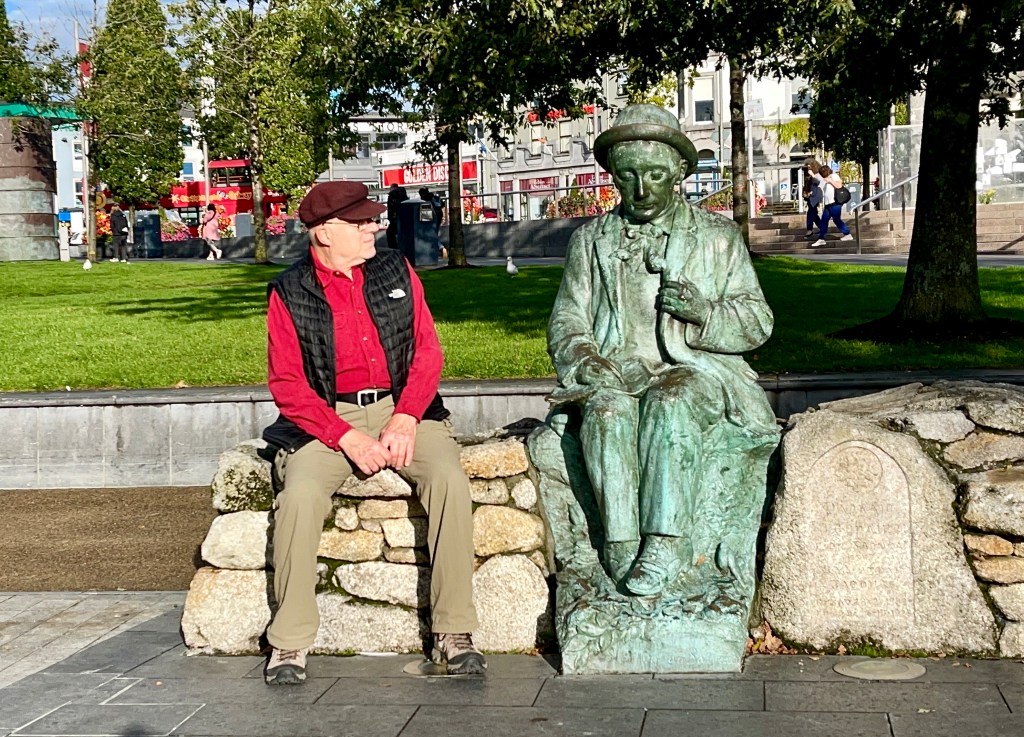
In late September I sat beside a statue of Irish poet Pádraic Ó Conaire in John F. Kennedy Memorial Park, Eyre Square, Galway. So much history and sadness seemed to come together in this image, in this park. JFK made a memorable journey through Ireland in June 1963, just 5 months before he was murdered. He gave a speech at this park attended by thousands (the Irish people loved it that one of their own had become the U.S. president). This statue of Pádraic Ó Conaire is a replica. The original is in the Galway City Museum where it was moved after vandals decapitated it in 1999. As I see it, this image of Ó Conaire, also known as Patrick O’Connor (he was a leader of the Irish language revival and wrote stories in Irish), shows him in a serious contemplation of sorrow, inspired by the book he’s reading. Not necessarily a sorrow regarding himself, but about the people he knew and wrote about it. Maybe that’s why the vandals attacked him: His inwardness, his ability to probe the sorrowful deep, to live with uncertainty, was too scary for the fools. Ó Conaire died in 1928 at about the age of 46.

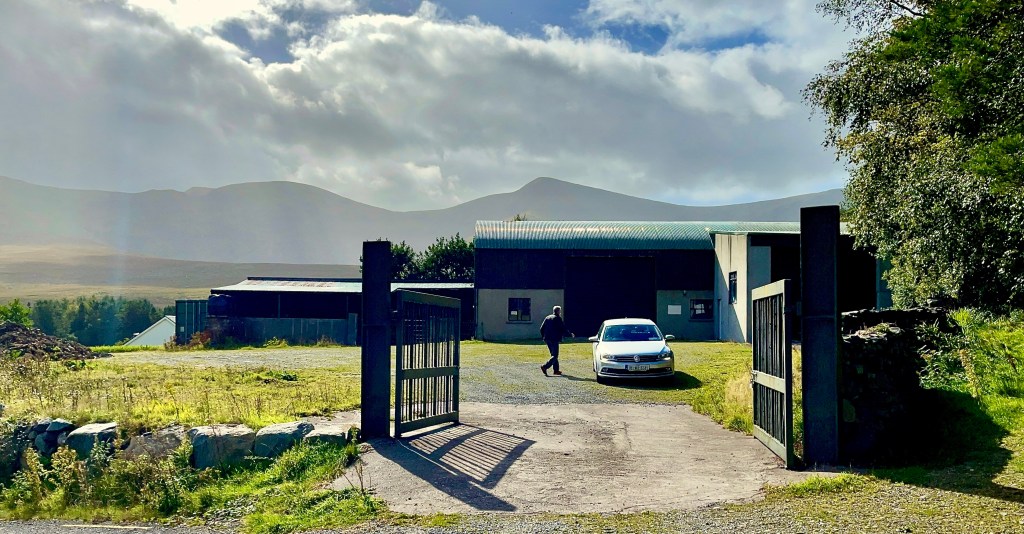
I can’t look at this photo without seeing a vista from somewhere out west in America. But it’s Ireland, near the town of Glenbeigh on the Iveragh peninsula, County Kerry. What I saw from inside our rented car and at those times when we stepped out into the towns or villages of west Ireland seemed no more developed than the American Southwest as I first saw it 43 years ago.

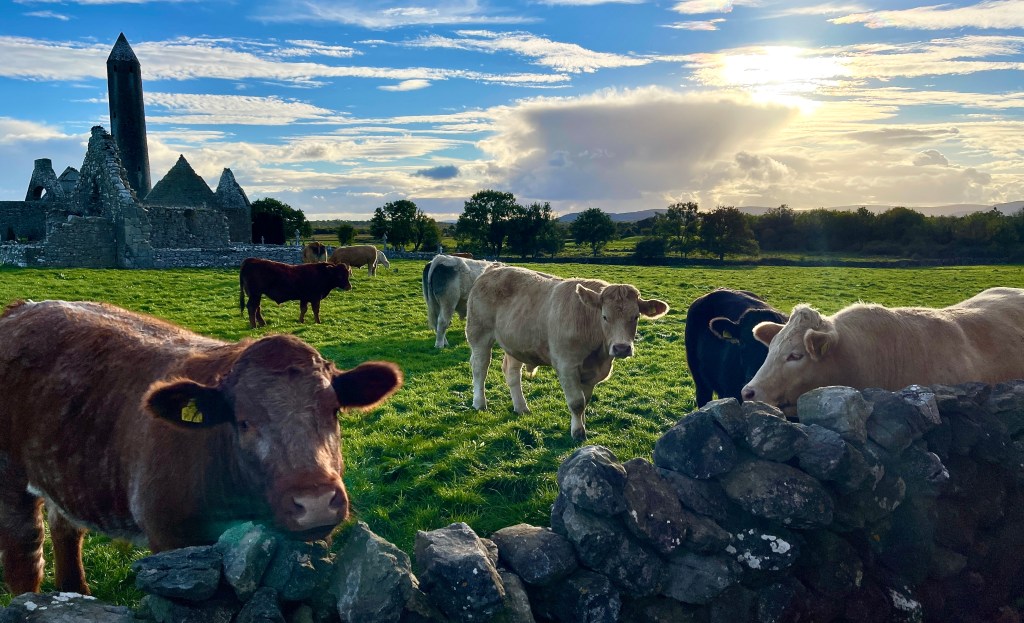
Stone walls, ruins of ancient stone buildings and cows (also sheep, horses & hedgerows) are everywhere in the countryside of west Ireland where we toured in September. We saw similar pastures during our drive from Sligo to Belfast, but it was in County Kerry, County Clare, County Galway, and County Sligo where we did most of our driving. ¶ The ruins in this photo are of the Kilmacduagh monastery in County Galway. According to on-site displays, the monastery was founded by St. Colman Mac Dutch early in the 7th century. The abbey is said to be one of the finest collections of monastic buildings in the country (there are more ruins than seen here). The churches were plundered in the 13th century but the site remained the Bishopric until the 16th century. The modern diocese still bears the name of the early monastery. ¶ The Round Tower seen in the background dates from around the 12th century. It functioned as a place of refuge for the monks in case of attack. ¶ The tower is actually a leaning tower: it tilts 2 feet from the perpendicular. For comparison, the taller Leaning Tower of Pisa leans 12 feet 10 inches from the vertical.

Which visitors to west Ireland do not visit the Cliffs of Moher? We were no different. The Cliffs may be Ireland’s most popular attraction. Their formation and strata make them a distant cousin to Arizona’s Grand Canyon, though they’re not nearly as high. Ancient river flow dropped sediments that, at the bottom of the cliffs, are more than 300 million years old. ¶ Visible out in the North Atlantic Ocean in this video are the Aran Islands, another tourist draw (which drew us one day), and beyond them a hint of the shores of Galway Bay. Note the cows, which (along w/ sheep) are impossible to avoid in Ireland.

Innisfree: Isle of Peace

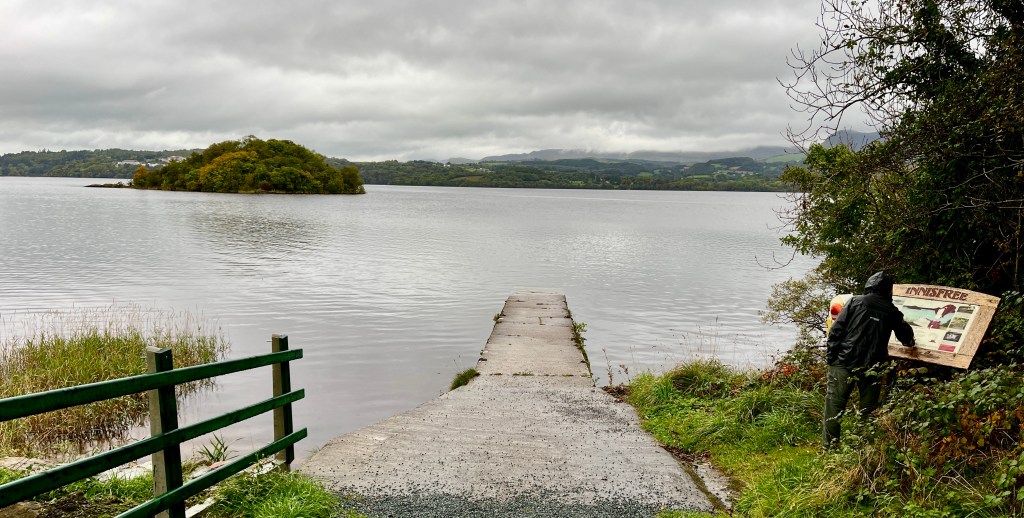
Lough Gill, not far from Sligo in County Sligo, Ireland, and the island Innisfree, written about in a famous poem by William Butler Yeats, who knew this country well.

Lough Gill is a freshwater lake near Sligo in west Ireland. The 5-mile-long lake, where people walk the nature trails through the surrounding woodlands, watch birds, and kayak on the water, is associated with a famous poem by the great Irish poet William Butler Yeats. The lake is not the focus of the poem. Instead, the poet draws our attention to a little island, the one you see here, whose name is Innisfree. Yeats wrote meditatively and symbolically about that island in a famous poem, “The Lake Isle of Innisfree.”

Yeats (1865-1939), who is buried in Drumcliff, 5 miles north of the town of Sligo, would spend summers in this region when he was a child and youth. If you travel through this country, as we did early this month, you’ll see a number of tributes to him, like the Yeats Country Hotel at Rosses Point, a little bit of land jutting into the sea where he and his family would vacation; a visually arresting statue of him (erected in 1989) in Sligo, a B&B named after him, and so on.

“The Lake Isle of Innisfree” was written in 1888 and first published in 1890.

<<<<<< >>>>>>

THE LAKE ISLE OF INNISFREE

by William Butler Yeats

I will arise and go now, and go to Innisfree,

And a small cabin build there, of clay and wattles made;

Nine bean-rows will I have there, a hive for the honey-bee,

And live alone in the bee-loud glade.

And I shall have some peace there, for peace comes dropping slow,

Dropping from the veils of the morning to where the cricket sings;

There midnight’s all a glimmer, and noon a purple glow,

And evening full of the linnet’s wings.

I will arise and go now, for always night and day

I hear lake water lapping with low sounds by the shore;

While I stand on the roadway, or on the pavements grey,

I hear it in the deep heart’s core.

<<<<<< >>>>>>

Yeats spoke about his inspiration for the poem in a moving and, for anyone interested in the creative process, fascinating way. The passage is almost as famous as the poem: “I had still the ambition,” he wrote, “formed in Sligo in my teens, of living in imitation of [Henry David] Thoreau on Innisfree, a little island in Lough Gill, and when walking through Fleet Street [in London] very homesick I heard a little tinkle of water and saw a fountain in a shop-window which balanced a little ball upon its jet, and began to remember lake water. From the sudden remembrance came my poem ‘Innisfree,’ my first lyric with anything in its rhythm of my own music.”

I first read Yeats’s poem in a course on modern poetry that I took in my final semester as an undergraduate a long time ago in The Bronx. The course was one of my most important learning experiences. I still have and still occasionally read my copy of the course text, Modern American and Modern British Poetry, an exhaustive anthology compiled by Louis Untermeyer and originally published in 1922 with later editions, including a revised, shorter edition published in 1955, which was the text we read. Until we began that course in mid-January 1969, I had never read anything by Yeats, T.S. Eliot, Ezra Pound, W.H. Auden, Wallace Stevens, Dylan Thomas, and other poets.

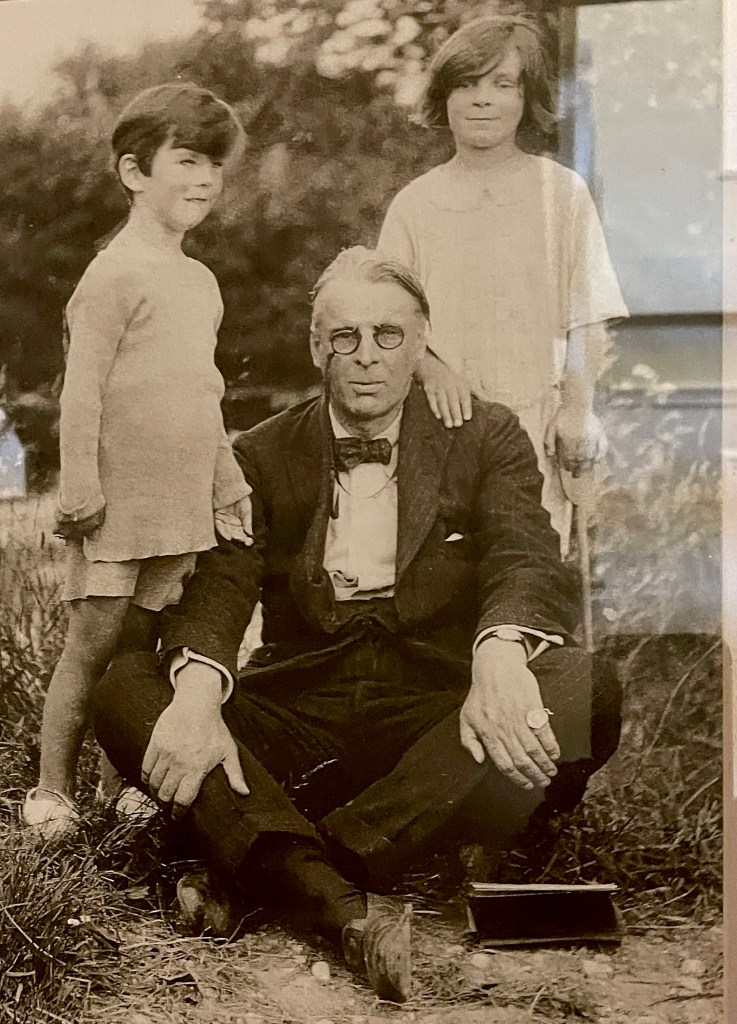
My photo is of a photograph displayed in the Yeats Country Hotel at Rosses Point, outside the town of Sligo, County Sligo, Ireland. (Names of children and date and place of photo unavailable.)

“The Lake Isle of Innisfree” was the first poem we read. After reading the poem aloud, our instructor, a classy Southerner with a tremendous passion for poetry and Shakespeare, opened the talk by placing Yeats’s poem into a broad cultural and political moment, the fin de siècle (“end of the century”). The term is often applied to the end of the 19th century and is taken to mean that Western culture (especially in France) was going through a period of lassitude, decadence, and decline. The professor pointed to the mood of the poem and in particular the first line: The speaker has been sitting or lying down and perhaps doing nothing more than thinking or dreaming, but nothing seriously worth mentioning. The poem doesn’t really start, doesn’t demand our attention, until he decides to get up and build his little Thoreauvian cabin, a refuge from the world, a place for solitude and contemplation but not for action in the social sense. He’ll be alone with the bees and the softly lapping water. He won’t engage with human institutions or his fellows.

How many people today feel exactly the same way as the poem’s speaker, who decides that the “bee-loud glade” and the song of the crickets and the “dropping slow” peace are all preferable to the ceaseless activity and madness of the cities and suburbs that we’re all trapped in? Many Alaskans, I’m sure, know exactly what I’m talking about.

By the way, I urge readers to listen to Yeats recite his own poem. I was much surprised when I first heard it. I never expected that Yeats’s “music” was so incantatory, although actually seeing his little island and knowing he was thinking about that place while walking around London makes me understand his poem more than I ever did.

Spirits of Galway

I love older well-designed, romantic pubs and restaurants, places with a human scale that above all are comfortable to the body and mind and pleasing to the eye. We stumbled on such a place one afternoon in the Latin Quarter of Galway. I managed to take this (jumpy) video of its interior — make that interiors, because this is a decorative warren of rooms and sub-rooms and little alcoves, an adult playset. And despite my penchant for the old, it’s been this way only since 1997 (but it looks old style). It consists of Malone’s Whiskey Bar, The Front Door, and a back gin bar (name forgotten) — all in all, 6 bars (not all shown) and assorted other hideaways on several floors. The whole of it was developed out of the lower floors of 3 separate houses. I was told that when they began, they didn’t have a final vision of what it would look like, just built one room first and then poked a hole in a wall and started making another, and so on. This is the end result.

>>>> <<<<

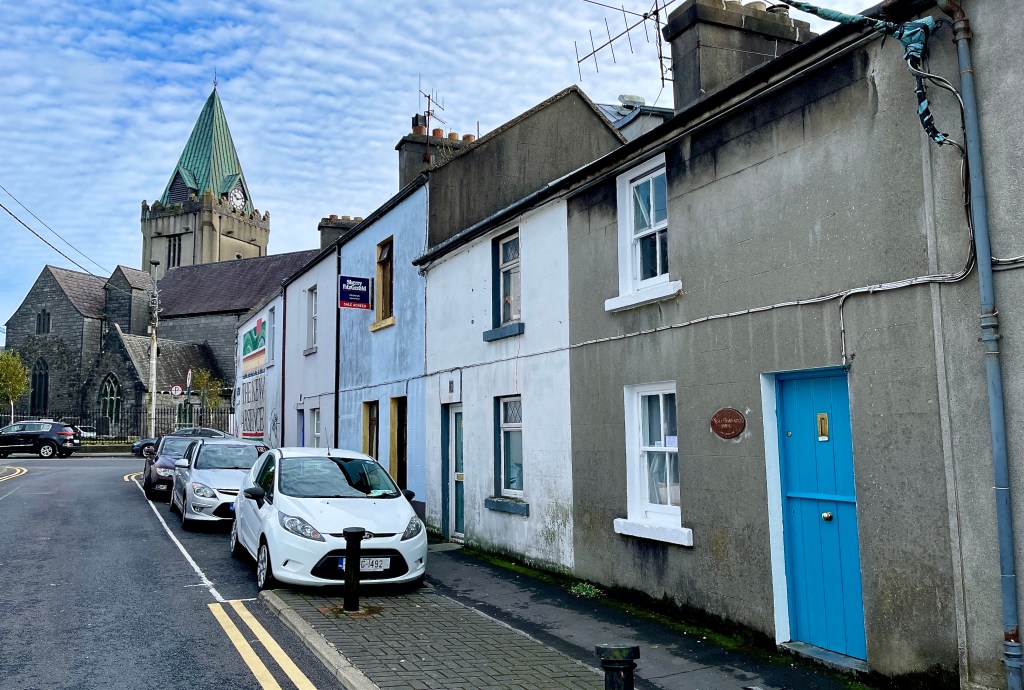
This street is Bowling Green in Galway. On the other side of St. Nicholas’s Church in the distance is The Latin Quarter. In the house on the right (with the oval plaque) there once lived one of the most famous muses in all literature: Nora Barnacle, who became the lover, mother of his two children and eventually wife of the Irish author James Joyce. Nora would move out of Galway to become a chambermaid in Dublin, which is where Joyce met her. To judge by the letters they wrote each other when they were apart for some time, Jim and Nora enjoyed as steamily erotic a relationship as any man & woman may enjoy. (I really do dare you to read those letters.) This house, which remained in Nora’s family for many years after she left, is exceptionally modest, perhaps even humble. ¶ Galway’s Latin Quarter is an exciting district of pubs, Irish music, restaurants, shops, etc. When we were there a few weeks ago (Sept. 27 to Oct. 1), I was struck by how the Irish girls and young women dressed to show a lot of skin, even though evening temperatures were in the 40s. And then I thought … How did Nora Barnacle (b. 1884) dress as a teenager and young adult in the late 19th and early 20th centuries? Ireland then was more repressive than it is today, so she was probably modest, well covered up. But maybe that’s why she moved to Dublin, the big Irish city. ¶ Joyce’s father, John Stanislaus Joyce, was a bit of a wit (a trait he passed on to his son). When he learned that Jim’s girl was named Barnacle, he quipped, “Well, she’ll never leave him.”

Tower of Literary Power

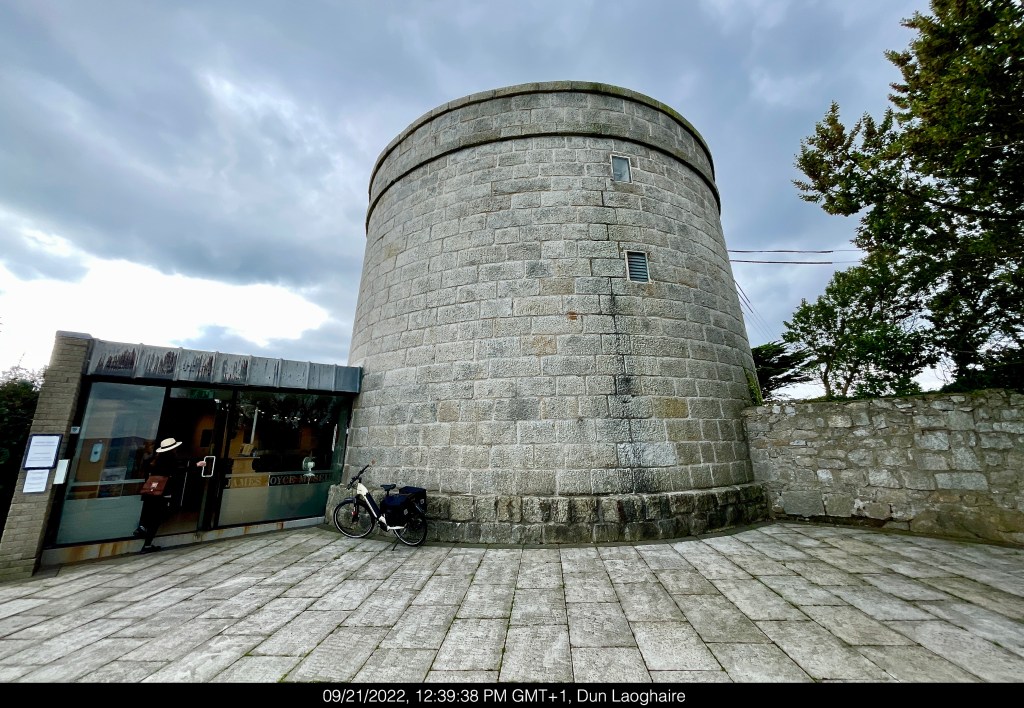
The James Joyce Museum (left) is an addition to the 1804 Martello Tower at Sandycove, located above the strand about 14km (8.6 miles) southeast of the Dublin city center.

Among my personal ambitions for this journey was to learn more about the Irish author James Joyce and to visit Dublin locations associated with him. It wouldn’t be my first time doing that. Kathleen and I came to Dublin for a few days in early January 1987 so she could research her Irish ancestry in order to obtain an Irish passport. I don’t exactly understand the arrangement whereby Ireland and the U.S. allow for dual citizenship between them, but Kathleen succeeded and eventually obtained Irish citizenship and the passport (her two brothers and our daughter likewise now enjoy that benefit). While visiting the repository of Irish vital statistics with her, I did a bit of research myself and came away with a photocopy of the small strip of paper that was the birth certificate of James Augustine Aloysius Joyce (Feb . 2, 1882).

During that visit 35 years ago, a Dublin cousin of Kathleen’s drove us to two sites linked to Joyce: one of the many places his family lived (their finances, which started out strong, grew weaker over time and they moved often), as well as the Martello Tower in Sandycove, south of the city along the shore of Dublin Bay. The tower is one of the best-known Joycean attractions — a large round stone fortification built in 1804 as one in a string of more than two dozen such towers that formed a defensive line stretching along the bay and to its north and south (the British were concerned that Napoleon might set up a base in eastern Ireland from which to attack them across the Irish Sea). The Martello Tower at Sandycove, No. 11, was also the place where Joyce not only lived for a brief spell, but where he sets the opening scenes of his best-known work, the novel “Ulysses.” Seeing the tower in the dark that evening 35 years ago, I didn’t know its full history or what to make of it. I don’t remember being impressed.

Recently, however, in preparation for this longer visit to Dublin, I learned that a museum of Joyce artifacts, letters, and the like is attached to the tower (has been since the 1960s), and it welcomes visitors, asking only for donations. So on the second day of our visit to Ireland, September 21, we took the DART train south to a Dublin suburb, walked less than a mile along a beautiful seashore and this time got to see the tower from the inside.

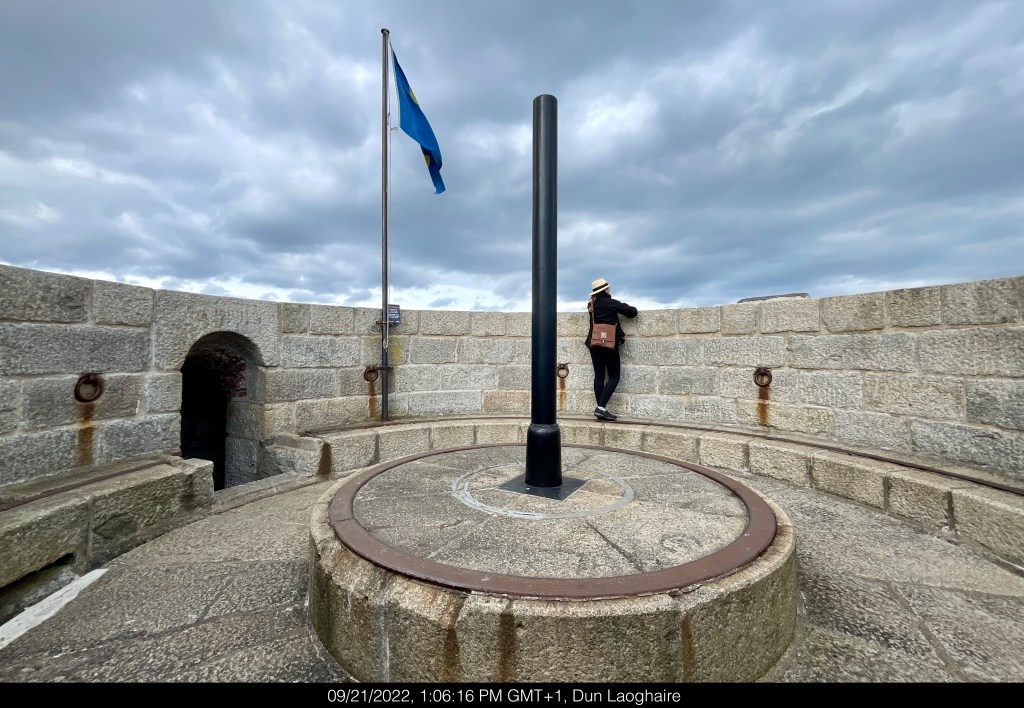
In the 1804 design of the Martello towers, a large cannon supported by a bulky wooden scaffold could rotate 360 degrees on the inner & outer rails visible here. Its range was about a mile. The coast of Dublin Bay was dotted with a couple dozen of the Martello Towers and effectively threatened any vessel coming within a mile of the shore. We were told that no Dublin Martello cannon was ever fired against an enemy. ¶ Here’s one of the reasons I think this structure is worth knowing about: The opening you see in the wall is the stairhead referred to in the first sentence of Joyce’s novel “Ulysses,” which reads: “Stately, plump Buck Mulligan came from the stairhead, bearing a bowl of lather on which a mirror and a razor lay crossed.” Another reason for wanting to learn more about this tower is what occurred inside it 100 years after it was erected. (See below.)

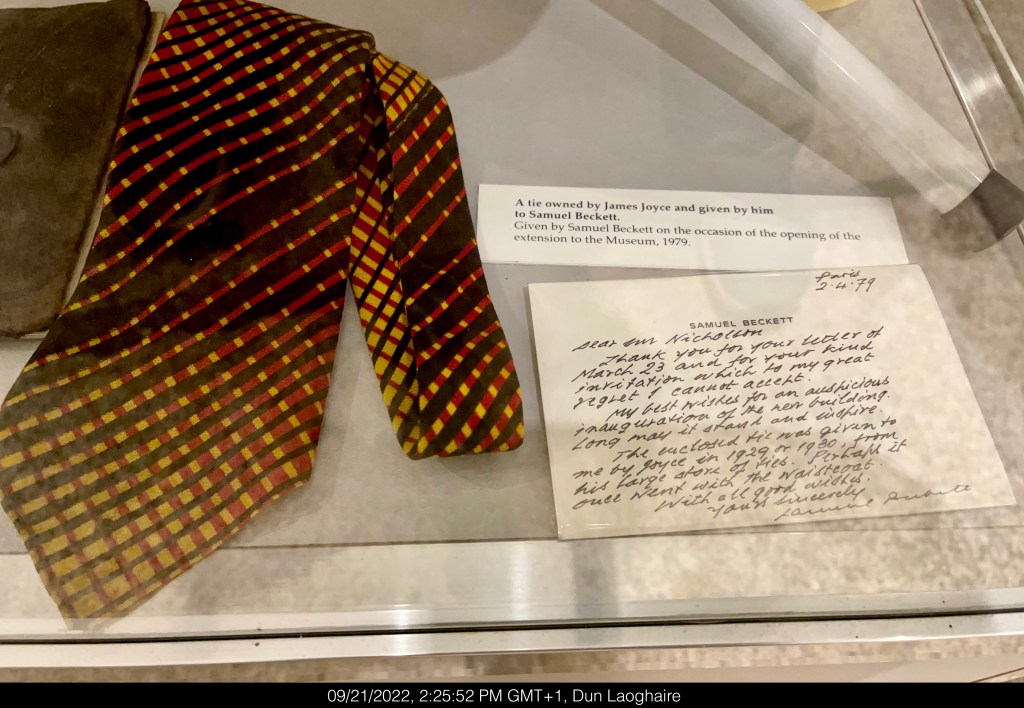
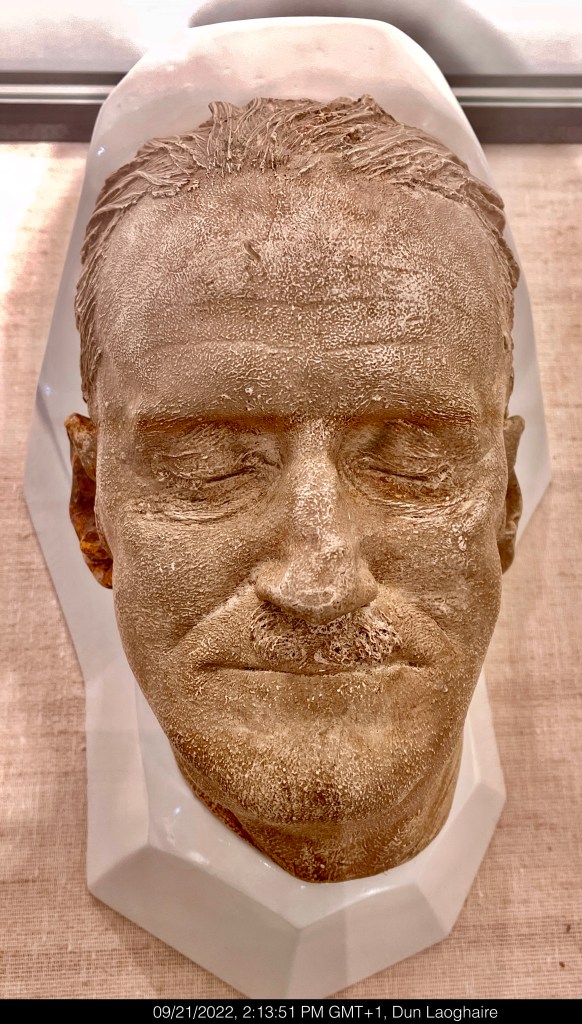
The museum, for those who want to know about Joyce, is excellent if small. It owns many priceless items, including a guitar he once played, his steamer trunk, a tie he gifted to the playwright and novelist Samuel Beckett, letters written by and to him, drawings of him, and many other artifacts, including Joyce’s death mask (photo below). The tower is fascinating, particularly the round interior room where Joyce’s friend, Oliver St. John Gogarty, invited him to live in late summer 1904. The attached photos tell more of the Joyce relationship with the tower, including what is alleged to have happened there one night not long after Joyce moved in.

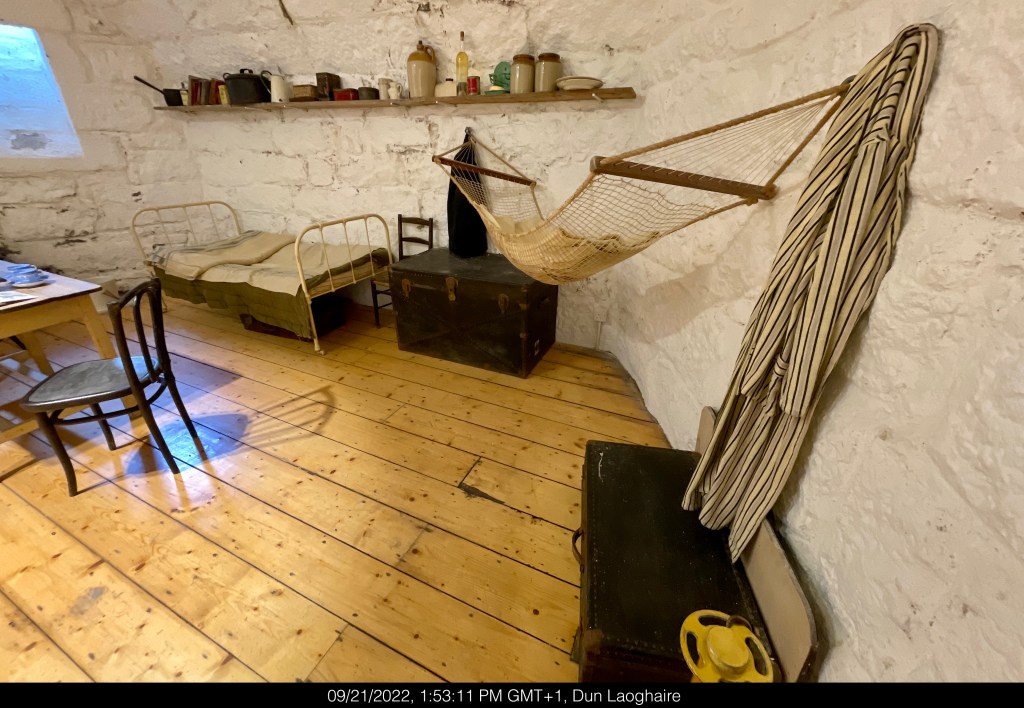
The place beneath the striped robe, where the brown valise lies, is where Joyce spent the first of his six nights in the tower in September 1904, at the invitation of a friend and fellow writer, Oliver St. John Gogarty, who had secured a lease and turned this room into an apartment. When a third man, Samuel Chenevix Trench, joined them, Joyce gave up his spot to Trench and slept where the bed in the photo is presently situated. In the caption for the next photo I recount what allegedly happened a few nights later. (Incidentally, none of the furnishings & objects in the “living quarters” of the tower are original but rather period pieces suggestive of past usage.
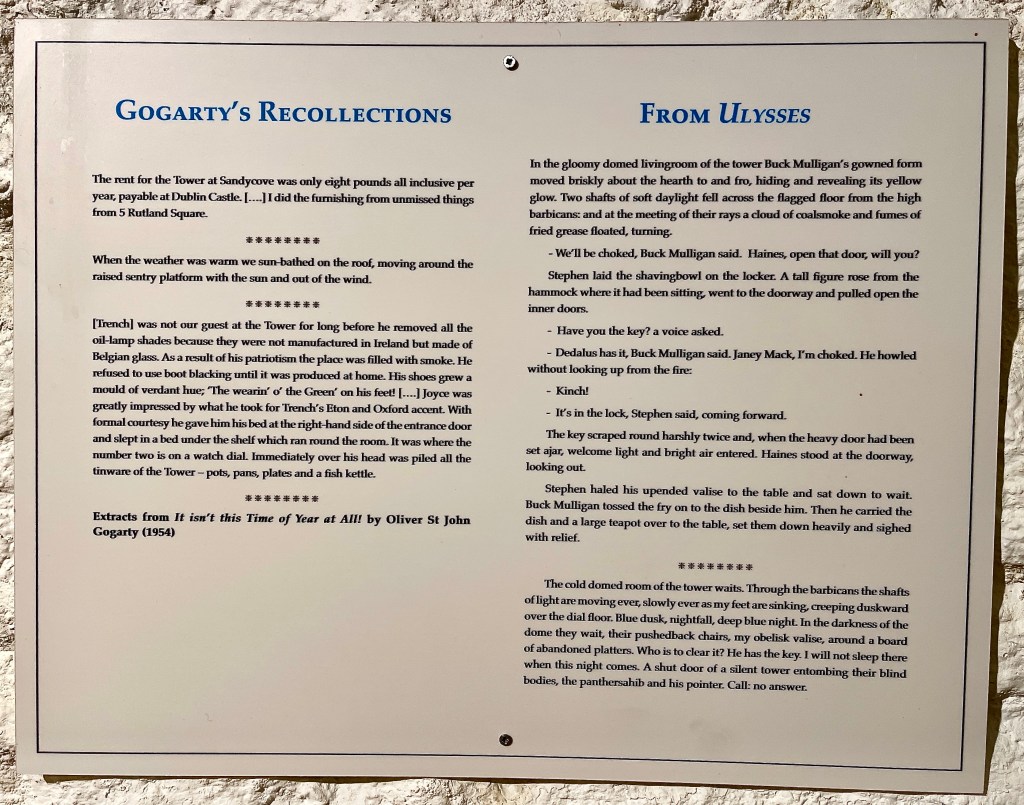
As a writer of fiction, Joyce was noted for his hyper-realism and for writing real people and real locations into his narratives. In “Ulysses,” his friend Gogarty becomes Buck Mulligan, Trench is Haines, and Joyce himself is Stephen Daedalus. The incident that’s alleged to have happened on the sixth night of Joyce’s stay at the No. 11 Martello tower (it is not fully told in the book) is that Trench awoke from a nightmare in which he was menaced by a black panther. He reached for his handgun and started firing. Gogarty grabbed the gun and fired at “all the tinware of the tower,” as Gogarty, in a later memoir, would call the pots & pans on the shelf above Joyce’s bed. Joyce was startled, left the tower, and several weeks later left Ireland with his paramour, Nora Barnacle. Joyce and Nora would never return intending to live together in Ireland and instead would take up residence first in Trieste, then in other cities, Zurich and Paris primarily, where he wrote his stories and novels.
A tie that Joyce owned and later gave as a gift to Samuel Beckett, the Irish playwright and novelist who was a admirer of Joyce, to the point that he became the elder writer’s secretary. Beckett gave the tie to the Joyce Museum at Sandycove.
ONE OF TWO PLASTER CASTS TAKEN FROM THE FACE OF THE BODY OF JAMES JOYCE, SHORTLY AFTER HIS DEATH IN ZÜRICH ON THE 13TH OF JANUARY 1941 … (Caption by James Joyce Tower & Museum, Sandycove.) I took all the photos in this post at the museum.

Launch on Landing

This is a new blog. I’m starting it to keep my friends & family up to date on three months of travels through Ireland, the U.K., France and Czechia (the Czech Republic). I say “up to date,” but I’m posting this on October 12, already more than three weeks into our journey. So, sort of like space-time, my timeline curves, due to the pull of gravitational laziness.

And technological under-performance. Regarding this software, the WordPress system of creating & maintaining blogs or websites or both, I’m a full-on newbie. Therefore I also face an enormous learning curve, which bends toward irregularity as I grope along trying to catch up. My initial hope for these posts, for example, imagined they would appear as we carried on and things occurred, more or less chronological with the events they recorded. That’s not going to happen. The fact that I actually managed a first posting is providential. As of this writing we are less than 40 hours from leaving Dublin for Liverpool, where I expect our experiences to spike in excitement. It would be nice if I was conversant with the rudiments of WordPress by then. Which means that events of the past three weeks, if worthy of a narrative, will appear when they appear.

All right, let’s get started.

We left Anchorage on September 18. After 26 hours of travel, door to door, we settled into our downtown Dublin hotel room, exhausted and worried over how long it would take before we could feel we had something to look forward to instead of dragging our asses for a week or more. But the next morning (Sept. 20), after a night of inadequate sleep, we went down to the hotel dining room and were jolted deliriously awake by a magnificent buffet breakfast. The abundance and range of food choices and its quality amounted to a fanfare announcing that we were on vacation and off to a good start. (For those who are curious, we were staying at Jurys Inn Dublin Parnell Street, part of a chain and a good and not too expensive hotel very well located.)

Soon we were walking south through sunny Dublin streets. We crossed the Liffey River, wound our way past a corner of the Trinity College campus, past the statue of Molly Malone and her disappearing neckline, and ended up at a pub and entertainment venue called the International Bar. At every street crossing we explicitly reminded ourselves to look right for oncoming left-side-of-the-road traffic. It’s one thing to sit inside a car moving around a comparatively quiescent town like Anchorage and another when, only two days later, unsteady because of a 9-timezone lag, you’re walking through crowds and crossing busy streets in a heavily motorized city like Dublin. We would later return to Dublin after exploring other parts of Ireland and Belfast, yet still we lack any real confidence on these streets. The other day I thought it was clear to cross a sharply curving single-lane roadway at an expansive intersection, but halfway across I had to scamper like a terrorized animal because of a huge onrushing bus whose driver apparently wanted to kill me.

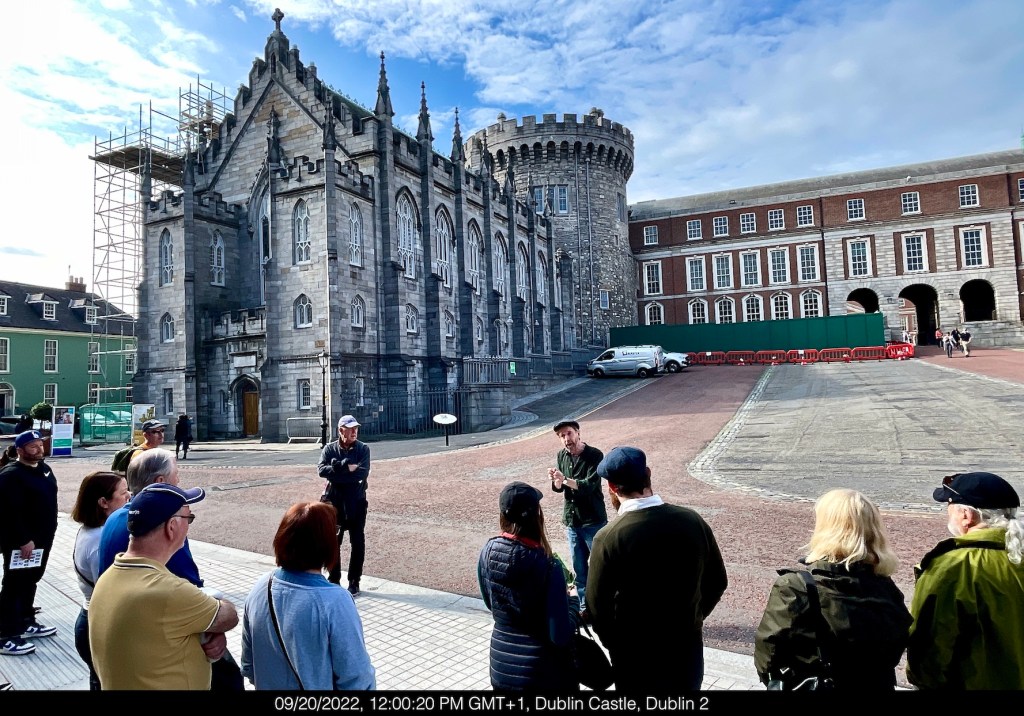
Jack, a Dublin theatre artist and amateur historian, leads a version of the “1916 Rebellion” historical tour on September 20, 2022. Dublin Castle behind him was the scene of some of the violence of the 1916 Easter Rising.

The International Bar is a comedy club. Kathleen and I and some 15 others were there to meet an actor and amateur historian who calls himself Jack. He would lead our group to major sites associated with the 1916 Rebellion, as the tour is named. The locations — Dublin Castle, the General Post Office, and others — are places where Irish revolutionaries instigated a violent uprising against their United Kingdom overlords (they chose Easter Week to set off their bombs and engage street battles with British soldiers and Irish constabularies due to the Easter “rising” of Jesus in the Christian iconography). No need here to recount the history of the next half-dozen years of violence and civil war that gave rise to a new nation, the Republic of Ireland (which notoriously did not include six counties of Ulster province — Northern Ireland). That history is available in many places online. However, this saga of the Irish independence movement dogged our travels throughout the island, including our visit to Belfast in Northern Island. It’s inescapable. Only a few hours ago, for instance, we toured Kilmainham Gaol (Jail) a few miles to the southwest of the city center, which is a site bitterly linked with the rebellion. So I hope to bring forward still more bits about our experience related to the events that a century ago gave Ireland its independence after 700 years of British rule.

Historical and other walking tours like The 1916 Rebellion have become a habit of Kathleen’s and mine. They’re an easy way to acquire a reasonably full picture of how specific locations fit into the larger narrative of important events. We’ve taken tours of sites linked to the birth of the Nazi Party in Munich, the concentration camps of Dachau and Buchenwald, World War 2 events in Prague and Paris, the Battle of Gettysburg, and key Spanish Civil War sites in Barcelona and Madrid. The tour leaders are generally knowledgeable authors, students or, like Jack in Dublin, artists with a passion for history.

So on that first day we quickly stepped into the role of inquisitive tourists getting our lick of Irish history, which was delivered exceptionally well. Jack is a slight, middle-aged Irishman, serious and talented. Occasionally he sang an Irish folk ballad to enhance the lesson. It became obvious he doesn’t think well of the English. When the recent death of the queen came up, he shrugged without sympathy.

Jack outside the G.P.O. on O’Connell Street, near the end of the tour. (We never got his surname.)