Former newspaper reporter and editor (Anchorage Daily News). Co-founder of the Alaska Poetry League and coach of the first Alaska teams to compete at the National Poetry Slam (2000, 2001). Adjunct instructor (expository, critical and creative writing) for 30 semesters at the U. of Alaska Anchorage. Volunteer-in-the-Park in Denali National Park and manager of Denali’s Kahiltna Base Camp (1986, 1987). Bronx native, son of immigrants from the Italian Mezzogiorno (Calabria and Lucania). Educated by Irish Catholics, liberal Jews, and the New York Review of Books. Husband to Kathleen, father of Maeve, and author of “Wind Blown and Dripping,” a play about Dashiell Hammett’s service as editor of a GI newspaper in the Aleutian Islands during WW2.
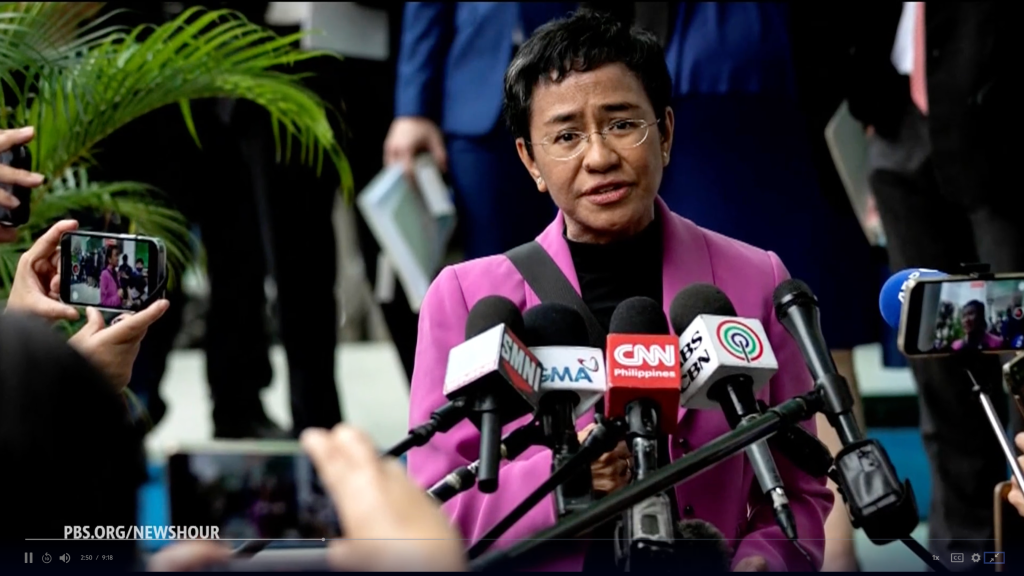
MARIA RESSA is a renowned kick-ass fighter for global press freedom, one of 2 winners of the 2021 Nobel Peace Prize and presently a journalism professor at Columbia U. in Manhattan. In her book “How To Stand Up To A Dictator,” Ressa tells of running the news site Rappler under the autocratic regime of Rodrigo Duterte, a murderous criminal and petty tyrant who served for six years (2016-2022) as president of the Philippines. Ressa eventually was arrested; even sort of knew it was coming. ¶¶ What follows is the transcript of the last half of her appearance Monday on the PBS NewsHour. The interviewer is Amna Nawaz. ¶¶ The parallels between what happened in the Philippines under Duterte and what’s happening now in the U.S. under our own criminal tyrant, DJ Trump, are all too evident. Something I’m feeling more and more, emphasized by Ressa, who is 61, is that there’s no time to lose. There’s no best time to fight a fascistic consolidation of power over the news media, the judiciary, the ideas allowed for discussion. The longer autocratic power sticks around, the stronger it gets, and the more dangerous.
< < < > > >
MARIA RESSA:
Don’t voluntarily give up your rights, right? I mean, again, in — I will give you our example in the Philippines, where the first newspaper gave up — the television station gave up largest — it lost its franchise or license to operate.
And guess what? It never regained it even after the time of Duterte. Little Rappler with, about 100, 120 people, we stood up. And it was difficult. It was frightening, but we’re still here, right? A point in time when I faced over a century in jail, but I’m still here.
And, after 2021, I had lost some of my rights. I wasn’t allowed to travel, for example, but now here I am. I’m in New York City teaching at Columbia University, right? So I guess what I’m saying is, hold the line is the phrase we use, because it’s connected to the rights that you deserve as a citizen.
And if you do not hold the line at this crucial moment — this is the moment when you are strongest — it will only — you will only get weaker over time. And it isn’t just the journalists, because journalists are the front lines in this, but the question is to every single citizen in America.
It’s the question I threw in the book, how to stand up to a dictator. And that question is simple. What are you willing to sacrifice for the truth? Because if you don’t have facts, you cannot — and I have said this over and over since 2016. Without facts, you can’t have truth. Without truth, you can’t have trust. Without these, we have no shared reality.
You can’t solve any problem, let alone existential ones like climate change. You can’t have journalism. You can’t have democracy. And in a system like that, only a dictatorship wins.
AMNA NAWAZ:
Maria, you’re drawing the comparisons here based on your lived experience, of course, but there are folks who will say, look, the U.S. is not the Philippines. Trump is not Duterte. Our democracy is not the same as the one that you lived in.
What do you say to that, the idea that this is somehow immune, our system, from the same things that the Philippines fell prey to?
MARIA RESSA:
I think I have two — two ways to respond to that. The first is, it isn’t just the Philippines. There is a dictator’s playbook, and you can look first at Russia, actually, even before that, Turkey, Hungary, Russia, right, with Putin taking office.
And the first step is really to get elected, once you’re elected, to crush the systems of checks and balances, and then replace them with your own — we’re starting to call them the broligarchy, because it’s far more potent, the tech guys are more potent than just normal oligarchies. This is political largess, political patronage.
You have to decide the world you want to live in. You have to decide whether rule of law exists. You cannot normalize impunity. And if you don’t, over time, we normalize that and you lose more and more of your rights.
But here’s a positive note. Rodrigo Duterte’s term ended. He had one six-year term. He did try to extend. And perhaps if the military had supported him, I wouldn’t be here. But we now have another president and those 10 criminal cases that I have had, I have now won eight of those 10 and two left. I still have to ask the Supreme Court for approval to travel, but we’re here.
It’s alarming to see it happening all over again.
AMNA NAWAZ:
We should point out, Maria, that the majority of Americans say they don’t even trust the media right now, that we have seen a decline in that trust over years. And many people like to see the president go after the press in the way that he does. They will hear this conversation and say, good, I’m glad he’s doing what he’s doing. What has the independent press ever done for me?
What would you say to them?
MARIA RESSA:
The role of journalists in a country, in a democracy like the Philippines, like the United States is to hold power to account. and I believe that is why — I mean, you’re not going to have an influencer or a content creator stand up to a dictator. You’re not going to have someone have a set of principles, of standards and ethics that actually pushes against their own self-interest. We’re seeing all of these begin to fall.
But here’s the thing. Part of what triggered that is the technology, the public information ecosystem we live in. Journalists and news organizations have been under attack from the very beginning. So your lack of faith in that is a self-fulfilling prophecy. You lose journalism the way we practice it, you lose democracy.
< < < > > >
Thank you to PBS for these materials. PBS — the PUBLIC Broadcasting System — is a news source owned by all Americans. And being public they are vulnerable, always have been, to political pressures. Trump’s FCC is currently investigating PBS and National Public Radio (related to on-air announcements by underwriters). Its chair has asked Congress to cut their federal funding, which is so tiny relative to the mammoth U.S. budget that it probably wouldn’t be enough to buy really cool T-shirts for Musk’s authorized gang of snoopers into all things Americancitizen.]
Howard Weaver, who led the Anchorage Daily News to victory in a classic newspaper war with the Anchorage Times, died a year ago today at age 73 (14 December 2023). In an obituary that appeared in the Daily News the following day, author Tom Kizzia, a long-time Daily News writer, gave a full and moving account of Weaver’s career and influence, calling him “the preeminent Alaska journalist of his generation.”
Both my wife and I worked in Weaver’s newsroom in Anchorage and knew the man’s leadership qualities, his commitment to producing a good, transparent and fair-minded newspaper, his strong ethical bearings, and other admirable traits. In 2012 Weaver published a memoir of his time at the Anchorage Daily News, starting when he was a cub reporter in his 20s and ending when he left the paper in 1995 to work in Sacramento, California, in several roles for the McClatchy Newspapers chain, owner at the time of the Daily News. I reviewed the book for the now defunct digital newspaper Alaska Dispatch and am now posting that 2012 review here.
The Daily News’s rivalry with the Anchorage Times and with the Alaska oil industry that actively took the Times’s side is a revealing and noteworthy newspaper story, complete with heroes and villains. A documentary of that newspaper war (not based on the book itself) is being made by a former Times journalist, Scott Lacy, who has conducted interviews with former employees of both papers. I don’t know when the doc will be completed and released, but I will update this post if and when I find out.
My review of Weaver’s book appears here as it did in the Alaska Dispatch, with minor exceptions.
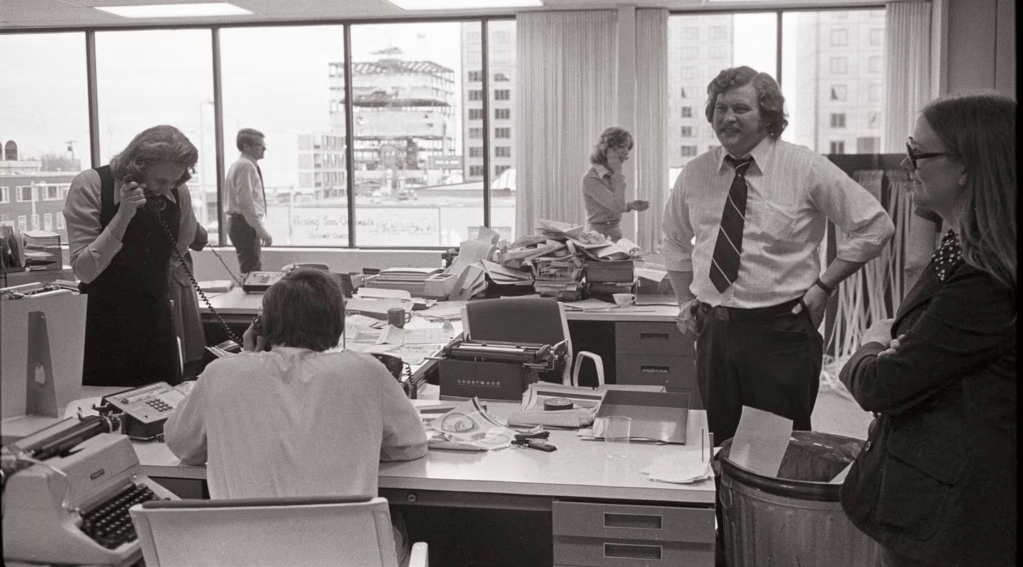
A 25-year-old Howard Weaver (wearing a tie) is shown after he has heard the news on May 3, 1976, that the Anchorage Daily News has won the Pulitzer Prize for Public Service. ADN publisher Kay Fanning is on the phone (left). (Photo: ADN Archive)
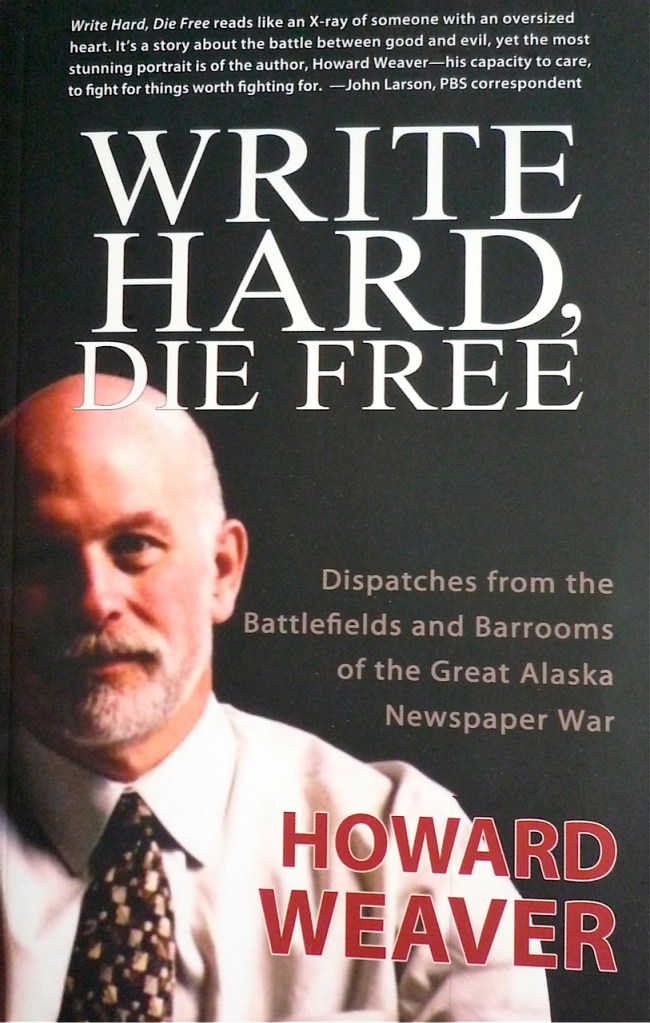
Write Hard, Die Free: Dispatches from the Battlefields and Barrooms of the Great Alaska Newspaper War. ¶¶ By Howard Weaver ¶¶ Epicenter Press (2012). 220 pages. With Index.
WHEN the Anchorage Times stopped its presses for the last time in June 1992, one of the last great newspaper rivalries of the 20th century came to a close. The Anchorage Daily News, having only a fifth of the circulation of the Times in the mid-1970s, overtaking it a mere decade later to become the largest daily in Alaska, now stood alone, one of the most powerful cultural institutions in the state. The Times had once exercised enormous influence, yet now it was dead, incredible as that seemed.
As Howard Weaver writes in his newly published memoir, Write Hard, Die Free, the Times’ fall was “a landmark event in Alaska journalism history.” Letting “certain success slip away,” the paper’s managers made “surely the worst (and dumbest) mistake in Alaska business history.”
Weaver was ADN’s chief editor for the last 10 years of the war and a reporter and editor at the paper for eight of the 10 years before that. He calls his book a “deeply personal view” of the war. And how! Anyone interested in a dispassionate account of a key moment in the post-pipeline history of Alaska needs to look elsewhere. But anyone who writes such a history will have to read Weaver’s memoir, because it is here that you get the view from inside the general’s tent.
Those who have known Weaver the journalist will immediately recognize him—the intelligence, the abundant humor (few people deliver a punch line as well), his moral commitment, sense of fairness, ample writer’s skills. Weaver is a son of Anchorage who became a star reporter at an early age, winning a Pulitzer Prize for Public Service at 25, and then rose through the ranks to lead the ADN to still more awards, including a second Pulitzer for Public Service in 1989, until finally, metaphorically, breaking the enemy’s sword across his knee. (Full disclosure: both my wife and I worked in ADN’s newsroom in the years Weaver was the paper’s lead editor and for some time after that.)
Write Hard, Die Free, subtitled “Dispatches from the Battlefields and Barrooms of the Great Alaska Newspaper War,” also gives us Weaver the man. Some revelations may surprise all but his closest friends, particularly a chapter in which Weaver goes into some uncomfortable detail about his struggles with booze, which reached a drunken climax one post-party, pre-dawn morning when he stopped his Saab at the side of a residential street in South Anchorage, crouched beside it, and vomited. Both his parents were alcoholics, Weaver says, and died relatively young—his father at 52, his mother at 46. His own story ends well enough—he goes clean at 35, right after those roadside heaves and a weeks-long bout of guilt, shame and visits to A.A.
Write Hard, Die Free is deeply personal in another respect, involving a key subtext of the newspaper competition, and that is the machinations of the Alaska oil industry. ADN’s clash with the industry characterized much of Weaver’s tenure and is an important theme of his book. In winning the war, ADN triumphed over Bill Allen and Veco, Allen’s oilfield-services company, the Times’ owner of record. The Times and the Alaska oil patch had been in bed together long before Allen made the marriage so explicit. Times publisher Robert Atwood, who had owned the paper since 1935 and sold it to Veco in 1989, was himself an oilman, having profited splendidly from lucrative oil leases on the Kenai acquired in the 1950s. Atwood never wasted a chance to print what Weaver calls “blizzards of advocacy coverage,” promoting any cause dear to the industry or, more generally, any big development project in the state. He even served for a spell as chair of the local chamber of commerce while still editing the Times.
“Whatever the journalistic logic of its boosterism,” Weaver writes, “the Times’ crusades were a consistent asset to its owner, who had made millions of dollars in the oilfields.”
To better understand the nature of Weaver’s David-and-Goliath conflict with the oil industry in Alaska, it’s necessary to consider his comparatively humble origins. Weaver seems never to have forgotten that he was a kid from a “shabby” working-class neighborhood in Muldoon. Nor did he forget what he learned from his father, a construction worker politically to the left of FDR. What his father gave him was concern for the ordinary citizen in that citizen’s eternal confrontation with the rich and the mighty. Weaver’s values of egalitarianism and of “afflicting the comfortable and comforting the afflicted”—an old and honorable newspapering tradition—derive from those paternal values. What also apparently derive from them are Weaver’s belief in candor, one-on-one trust, and open government, among other values. Only those who have worked in Weaver’s newsroom, or who read his book and learn of his particular theory of managerial leadership (which I’m not going to give away here, except to say that it’s part Hemingway and part N.Y. Yankees), can appreciate how his sense of fairness and basic trust made his staff of ordinarily cynical newshounds willing to do almost anything he asked of them—and most of the time he did not have to ask.
Who Weaver is—what his memoir conveys about the man—explain to a large degree why some pages fairly drip with revulsion at the Times’ lack of basic journalistic ethics. But he reserves his most pointed attacks for Allen’s personal behavior. Allen, Weaver reminds us, patronized young prostitutes, including teenage girls, and later was caught bribing state lawmakers (while at the same lavishing contempt on them). Words Weaver uses in connection with Allen include “pervert” and “sordid.” Perhaps the biggest regret of Weaver’s career at ADN, he tells us, is that he feels Allen managed to irrevocably stain the Daily News. Here’s how that happened.
In his book we learn, most of us for the first time, how the Voice of the Times, the defunct paper’s editorial remnant, managed to secure a toehold on a daily half page opposite ADN’s editorials and opinion columns and keep it for nearly 15 years. The manifest story, of course, is that Allen negotiated with McClatchy Newspapers, ADN’s owner, to close his paper and sell most of its assets to the Daily News for an undisclosed sum—a “not large” amount, writes Weaver, who does not reveal the selling price here (a deal is a deal, I feel sure he would say). A key part of the arrangement was that ADN would publish Voice of the Times for five years, the contract renewable every five years, giving Allen the conservative and decidedly pro-oil editorial presence in the state’s largest paper that he craved.
But where did Allen come up with such a peculiar notion? Weaver tells about a lunch he had a few months before the Times’ end with “Big Ed” Dankworth, lobbyist, former legislator and an associate of Allen’s who had known Weaver since the early 1970s when Weaver was a young cop reporter for ADN. The conversation turned to the topic of the Times giving up the ghost because “you boys are bleedin’ ol’ Bill Allen pretty good,” Dankworth said. Weaver responded that the bleeding could end easily. “All he has to do is quit.”
Never happen, Dankworth said. “He wouldn’t give up his editorial page.”
Weaver let Dankworth know that a newspaper war in Shreveport, Louisiana, had ended with the victor giving the vanquished paper an editorial page in the interest of publishing a diversity of views.
“Things like that can be worked out,” Weaver said.
A few months later, the Times cried uncle and initiated the proposal that McClatchy would buy it out and thereby end the hemorrhaging of Allen’s millions. Negotiations over the general shape of the deal went smoothly for the most part. The sticking point was Allen’s demand for an editorial page in ADN, a proposal that worried Weaver and ADN publisher Jerry Grilly, who pushed for tighter control over Voice of the Times than the ADN ultimately got.
After the FBI videotaped Allen bribing Alaska lawmakers and he turned state’s witness to avoid criminal charges, and after he proved himself a Grade A creep in the matter of teenage prostitutes, Weaver found himself full of regret.
“… I wish I’d had more doubts or reservations at the time of the deal, or that my cautionary arguments had been more persuasive,” he confesses. “Instead I now live with the knowledge that the idea probably originated with me—that the seed got planted in Allen’s conniving mind on account of my conversation with Big Ed.
“That hurts.”
How did the Daily News defeat the much larger and wealthier Times?
How did the “quest for decent journalism,” as Weaver defines it, succeed “against imposing odds”? This is a story with appeal for almost anyone, journalist or not, because it is a compelling and cautionary tale in itself, and Weaver tells it well and does not make the result seem inevitable.
To start with, the victory took guts. Publisher Kay Fanning simply refused to give up, even when ADN was on life support, tethered to the Times in a miserable joint operating agreement. Having her back to the wall only seemed to stiffen it. Her courage would later inspire the future ADN editor. In 1975, she sent Weaver and another reporter—that is, a third of the paper’s entire reporting staff—to go snooping around the Teamsters, thereby taking on one of the most powerful forces in the still-raw state at the time of the building of the trans-Alaska oil pipeline. The resulting exposé won the paper its first Pulitzer.
C.K. McClatchy, head of the family newspaper chain headquartered in Sacramento, Calif., plays the role of the cavalry in this telling. He was another gutsy fighter in the war. C.K. threw Fanning the lifeline ADN needed in 1979, purchasing 80 percent of the paper—the deal set up by nothing more, so the story goes, than a handshake. Soon McClatchy was pouring millions into ADN and the paper began hiring dozens of reporters, editors, photographers and illustrators. The battle was fully engaged.
Weaver credits a McClatchy consultant, a Harvard Business grad, with the creation of the big-picture strategy that gave the paper’s managers and editors a steady focus on their ultimate goal of publishing a great newspaper. In practice, that meant reporting and editing and photography and design that put readers first, giving them interesting, well-crafted, attractive stories about Alaskans like themselves as opposed to telling them what a good job the oil companies were doing,
And then the Times itself helped to dig its own grave by being, as Weaver puts it, “an awful newspaper—lazy, partisan, and vindictive. Lucky for us, it was also smug, lifeless, and dull.” The Times could have checked the ADN’s rise. It could have changed to morning distribution, for one thing, going head-to-head with the News; afternoon papers had been dinosaurs since at least the 1970s. The Times also could have taken ADN’s journalistic standards seriously and perhaps broadened its own news coverage. Instead, its dopey-headed managers refused to believe the ADN was gaining on them at all, until it was too late.
Today1, 20 years after ADN’s victory over the Times and 17 years after Weaver left Alaska “mainly because it broke my heart” through its continuing embrace of Big Oil, the Anchorage Daily News is, if not a shadow of itself, certainly a much reduced version. It employs less than half the number of reporters and editors it did in its heyday. It enjoys few of the investigative resources it wielded with great effect in the 1980s and ‘90s. Where it had once set the agenda for many news organizations across the state, today it pretty much reacts to events—which is what the great majority of newspapers do anyway. But compared with the initiative ADN took under Weaver (blessed with the financial and moral backing of C.K. McClatchy, who died in 1989), and compared with the enterprise stories and investigative projects the paper once embarked upon, the ADN today cannot be called the same newspaper. Reading Weaver’s chapter on the People in Peril series—an array of stories and photos that informed the state, with real and lasting impact, about the suicide epidemic among Alaska Natives and its causes and which won the paper the 1989 Pulitzer—is to more fully appreciate that wildly expensive and audacious enterprise as a genuine miracle but, sadly, one that’s probably impossible to do today.
Disappointingly, Weaver says hardly anything about the massively scaled-back replica of the paper he once led. He does allude, briefly, to what is perhaps the greatest force withering newspapers everywhere: the rise of online media that have dragged ADN into “the most turbulent period in its history.” And Weaver reiterates what he has said in other contexts, that the practice of good journalism translates well from newsprint to digital forms, a positive prognosis that we can only hope turns out to be widely true. Supporting Weaver’s view while working to assuage any worries I or others might have about a decline in the quality of independent journalism are ADN’s online presence and the digital-only platform of the news organ you’re reading now2.
But is ADN’s status today as a news-gathering organization the result only of an Internet-driven retrenchment? Did McClatchy’s corporate decisions play any part? Weaver departed ADN and Alaska in 1995 and eventually became vice president for news for McClatchy Newspapers, a position he held until he retired in December 2008. He must have a view on how well the company has responded to the competitive pressures of digital media and the drastic loss of advertising revenue occasioned by the Great Recession3. He must have considered whether the enormous debt incurred through McClatchy’s purchase of Knight-Ridder Newspapers in 2006 has hobbled a newspaper like ADN, whose profits, all but guaranteed through draconian cost cutting, flow relentlessly to Sacramento. Weaver is silent on those questions. His memoir, of course, is meant to cover his years as a journalist in Alaska, not the aftermath. Still, besides reminding us that recent years have been turbulent, hasn’t he anything else to say about ADN today? The rest of us are left to wonder what stories locally are not being covered and, in fact, are not even known to exist.
The ADN’s position today is doubly, bitterly ironic. The newsroom has shrunken to a corner on the first floor of the large Daily News building in East Anchorage. Upstairs, an oilfield services company presently occupies offices carved out of the former newsroom where People in Peril and countless other stories were planned and written4.
In an Epilogue, Weaver indicates that his next non-fiction book will tell the “story of [Alaska’s] disappearing frontier and eroding culture,” a deterioration reflected in the country as a whole and whose supreme representative, Weaver says, is Sarah Palin. That might be the Howard Weaver commentary on his not-quite-vanished morning newspaper that we’d like to have.
For the time being, Write Hard, Die Free reminds us that Weaver’s tenure at the Anchorage Daily News was a Camelot moment in Alaska journalism—a battle fought vigorously and with the highest standards for a worthy cause, and which ended in a rare victory.
1 — As I say in the intro above, this review was published in 2012. My files tell me it was published in April.
2 — The Alaska Dispatch, after going through a turbulent period during which it purchased the ADN in 2014 and issued a combined digital and print product called the Alaska Dispatch News, eventually declared bankruptcy in 2017 and ceased publication. New owners changed the name back to the Anchorage Daily News. Now, in December 2024, the ADN is a two-days-per-week print product as well as an online publication.
3 — 2008-2009.
4 — As of December 2024, the oilfield-services firm is gone and the building is occupied by a telecommunications company.
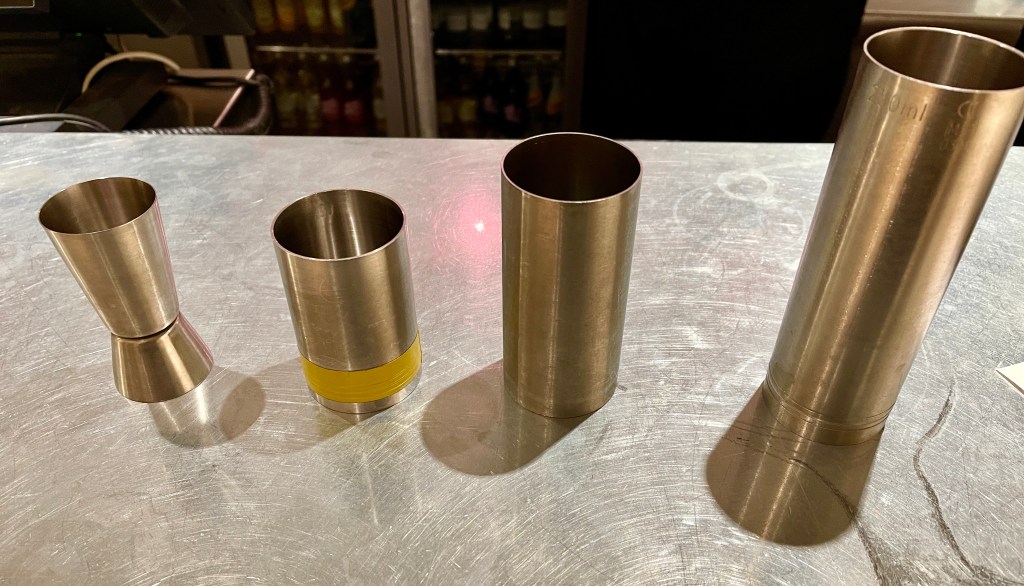
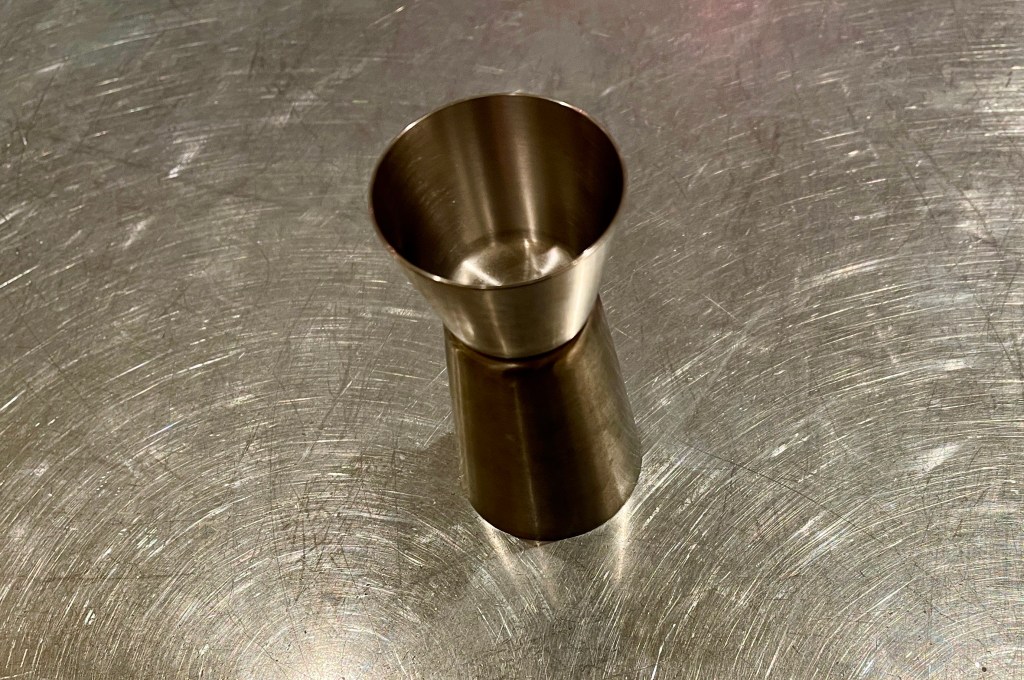
Measure for measure, the English people may be among the most disciplined drinkers on earth. Bartenders are required by law (and by their bosses and bar owners) to dispense certain types of alcoholic beverages in precise amounts, what the law calls “specified quantities,” when serving by the glass. So, for example, when you order still wine at the bar or at table, you’ll likely be offered a choice of small, medium or large. Those sizes correspond to 125 ml, 175 ml and 250 ml (roughly 4¼, 6 and 8½ fluid oz.). At a theatre bar where we recently drank, the barkeep would dole out those amounts in, respectively, the 2nd, 3rd and 4th measuring cups seen in the photo. The 1st cup is for measuring certain spirits — gin, rum, vodka & whiskey. With this end up, as seen in the photo, you can measure out 50 ml. (roughly 1¾ oz.), or what officially amounts to a double shot. Turn the cup over — as in the photo below — and you have the means to pour a single shot, 25 ml. ¶ I’m not certain, but I believe that Irish bars may have to dispense with their beverages under similar guidelines. I wondered, when we were in Ireland and later during our first travels through England, why the drinks uniformly seemed pallid. I seriously wondered, for example, if the gin was being watered down (the Negronis I ordered one evening at a wonderful oyster bar in Galway were frankly of no consequence whatever, and I departed an unhappy patron). But now I think I understand: When ordering certain cocktails, you’ll probably want to make it a double shot and, depending on your taste, budget and tolerance, perhaps order more than one.
A cup for measuring out an exact shot of gin, rum, vodka or whiskey as defined by alcohol-beverage regulations in the U.K., according to a bartender in Cambridge, England. Turn the cup over and you can pour an exact double.
What about American bars & restaurants — what limitations determine the amounts they pour into wine and cocktail glasses? I have not researched this — that is, whether a certain set of regulations governs the quantity you’ll receive when ordering a drink in the States. But my experience tells me it’s entirely up to the bartender. If they’re friendly, if they like you, you’ll get a generous pour. Or buy that second glass of wine. I have often noticed that the second pour is larger than the first. Perhaps it’s a reward for opening your wallet a bit wider.
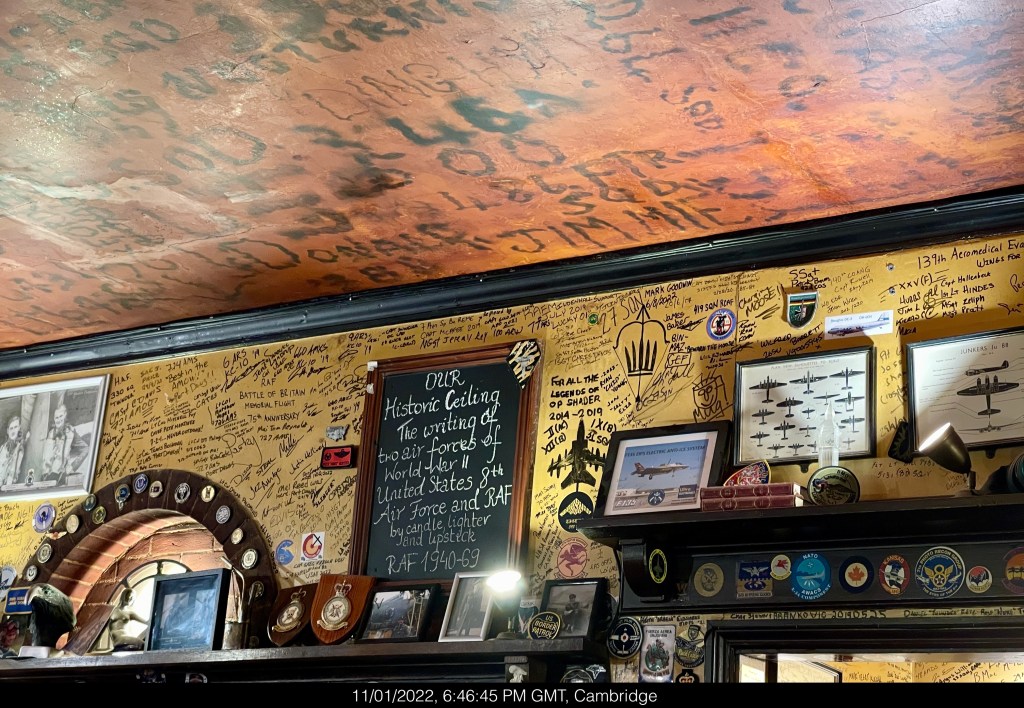
The writing is on the wall at The Eagle, probably the most famous pub in Cambridge, England, a city that just may have more pubs & restaurants per block than anywhere else in the sceptered isle. History is what gives The Eagle its cachet. It claims to date from as far back as 1667, although some sites place its beginnings in the middle ages. We stopped in for dinner and a pint the night we arrived in Cambridge to take in its considerable history. ¶ During WWII, British and American pilots and bomber crews stationed in this part of England (airmen of both nations during the war were quartered over much of Great Britain) would put aside their concerns and their rivalries and drink away an evening at The Eagle. While there, they scrawled their names, the names of their units, their planes, any numbers that meant something to them, on the ceiling. They used (as the sign you can see in the still photo says) candles and lipstick. ¶ Those scrawls remain today. The notation of important data and airmen’s names enjoys a long tradition at the Eagle, and it went on after the war. The walls here, as you will see in these images, are smothered with flyboy graffiti. ¶ Another story told by pub workers and patrons and reiterated in many other places is how, on the evening of February 28, 1953, molecular biologists Francis Crick and James Watson, who were researchers at Cambridge U. and who were said to frequent the Eagle six nights of every seven, stood up in an ale-infused euphoria to announce they’d found “the secret of life” — that is, they had discovered the double-helix structure of the DNA molecule. Some of this is probably an exaggeration. It appears more the case that on that evening Crick came to the pub where he and Watson were regulars to make the announcement to others in their circle. ¶ Another fact regarding the discovery of DNA that is less colorful and certainly less bruited is the part played by a woman scientist, Rosalind Franklin, in giving Watson & Crick invaluable information through her own experiments involving the shape of molecules. She died some years before the two scientists (and a 3rd, Maurice Hugh Frederick Wilkins) won the 1962 Nobel Prize for their discovery.
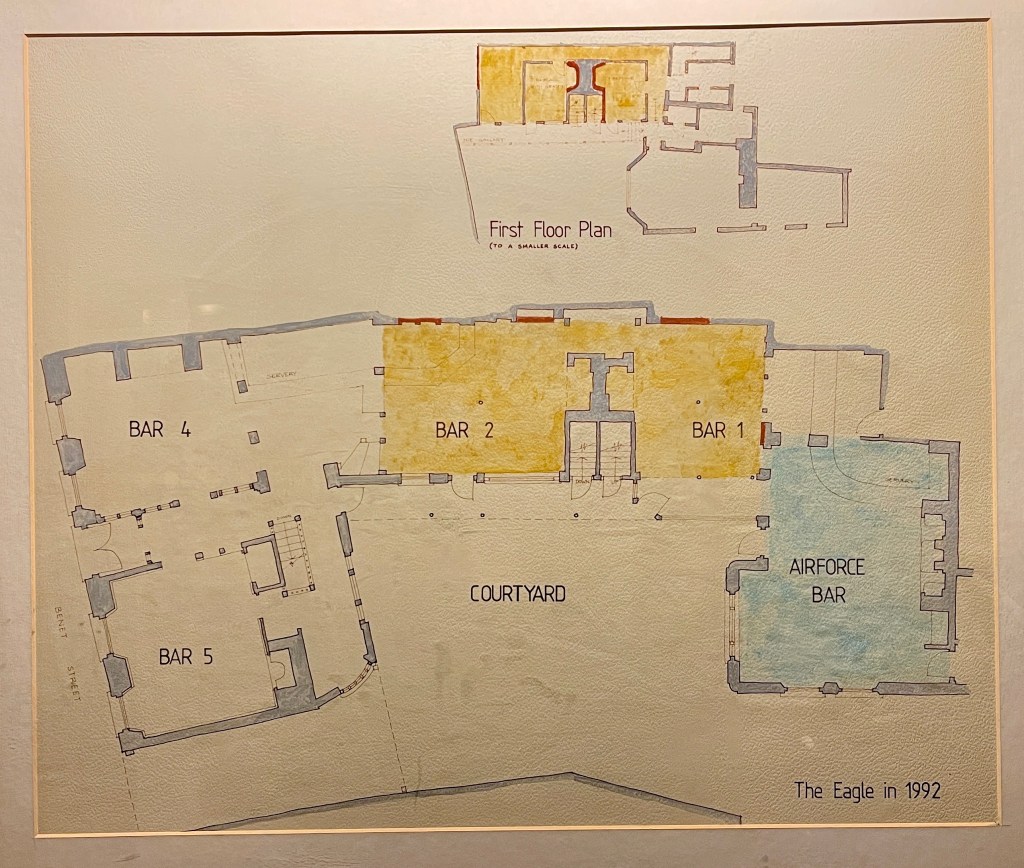
Part of the ceiling and a wall in “the RAF bar,” one of the five bars at The Eagle, perhaps the most famous pub in Cambridge, England. (Pub’s floor plan in next photo.)A 1992 drawing of The Eagle’s floor plan hangs on a passageway wall at the pub.
<<<<<<<< >>>>>>>>
This is my final “Pico Pub Crawl” for the reasons given in my previous post. But it’s not our final visit to old English pubs, which is among our favorite ways to burn time. On Sunday morning we leave for London. ¶ For those following our journey, we changed our plans and now will return to the States in late November. We had plans to visit Normandy and Paris after the U.K. and to end up with 10 days in Prague, but we’re approaching burnout. Also, we got sick. Kathleen and I each came down with a nasty bug as well as conjunctivitis (we tested negative for Covid). We appear to be mostly clear of it now but we’ve lost energy. Still, we’ll try to finish up in a big way — 12 days in London.
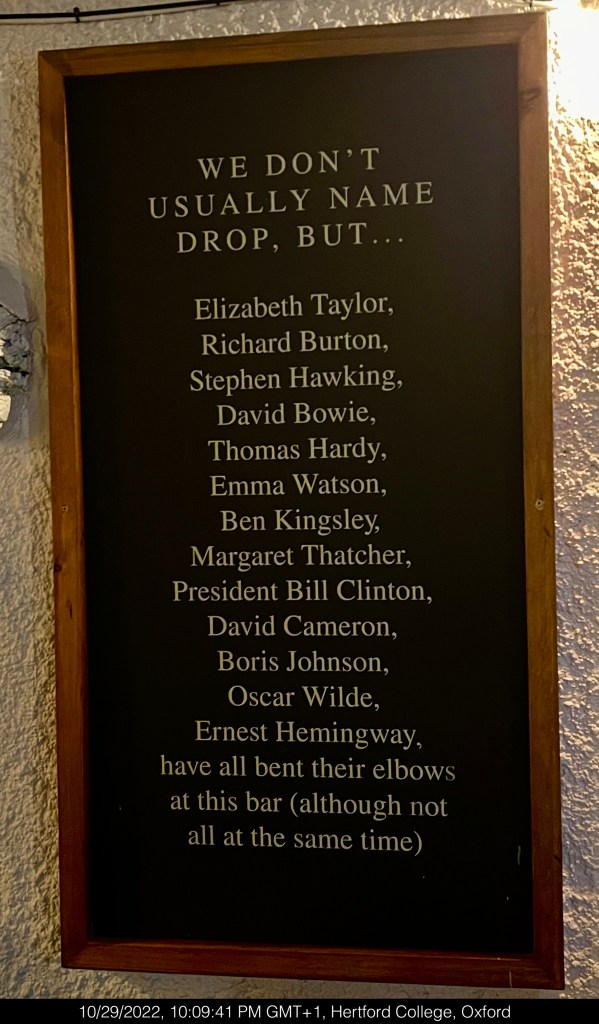
This is a late October look at the The Turf, a famous hole-in-the-wall pub in Oxford, England, a town where the city is synonymous with the university. The Turf Tavern is ensconced in a hidden byway of what I think is one of the university’s colleges, or maybe nestled between two colleges. I’m not sure. But it’s such a meme to actually locate the pub that I saw T-shirts with a slogan something like “I found The Turf!” ¶ I have made these “pub crawl” videos for several reasons: a) because I love Irish and English pubs of strong and distinctive character, a look & feel that have carried forward, in some cases, for centuries; b) because eating & drinking at these establishments is a pleasureable and relatively inexpensive way to get our calories, and so they’ve become a necessary and enjoyable part of this journey, thus part of what I’m showing through this blog; c) because part of living in Anchorage, Alaska, is to know I’ll never see anything like this there, so I’m having the experience of patronizing such a place more than once — many times more than once if I can stand to look at these videos again. ¶ Which brings up a problem with them: Those who’ve looked at the two I’ve posted so far and now at a third will notice that they’re repetitive. People — workers and patrons — are certainly active but they don’t have an unlimited repertoire of activities. So the charm is wearing off. You can do only so much with a camera held at your belt buckle as you walk about a well-occupied venue without trying to attract attention. Therefore, the next “pub crawl” video I post will be the last, at least until I find something new to do with them. But the next one will be a nearly 2-minute glimpse through an absolutely fantastic pub, with a fantastic history.
This board hangs along one of The Turf’s passageways & outdoor eating alcoves.
This is the inside of a Dublin pub called The Celt, shown on a Sunday evening in early October. (The first pub in which I walked around w/ my phone/camera leading the way is The Front Door in Galway City.) The Celt is located on Talbot Street in a district north of the River Liffey. Talbot needs some introduction. Although it is a calm and fairly dignified commercial and residential street today, it’s said to have been a boundary of the infamous Monto, Dublin’s red-light district and the largest in Europe during its 19th-20th-century prime. British soldiers were the johns in many cases, so when Ireland won its independence from Britiain in 1921 and set up the Irish Free State in 1922 (that is, for all but the six counties of Ulster Province in the north), the soldiers went home and the chief industry of the Monto district declined. ¶ But when it was going strong, it was notorious for disease and filth and poverty. In James Joyce’s novel “UIysses,” the two protagonists, Leopold Bloom and Stephen Daedalus, visit a brothel in the Monto, but that whorehouse is nowhere as shabby as the more typical brothel apparently was. ¶ We visted the Celt more than once. The energy to be seen in this brief video is mild compared with how electric the place can be. ¶ The second video in this post (below) gives a sample of the live music heard every night.
We left Ireland on October 14, having spent 3½ week there, including 4 days in Belfast, Northern Ireland (part of the U.K.). For much of that time, I traveled as a sideman as my wife and her brother pursued family roots. All 4 of their grandparents were born in Ireland and emigrated, ending up in the U.S. But Kathleen and her brother Kevin wanted to dig further along the family tree, and their genealogical search bore tremendous fruits. They met an Irishman who is a third cousin and whom, until only a few months earlier, they knew nothing about. With the enthusiastic support of newly acquainted relative Maurice Daly, a retired school principal who lives outside of Dublin, we visited a farm in the vicinity of the parish of Aghadoe in Country Kerry where Kevin’s and Kathleen’s great-grandfather and Maurice’s great-grandfather, the brothers Cronin, had lived and worked. We walked the grounds of an old cemetery and, with Maurice’s guidance, found the Cronins’ graves.
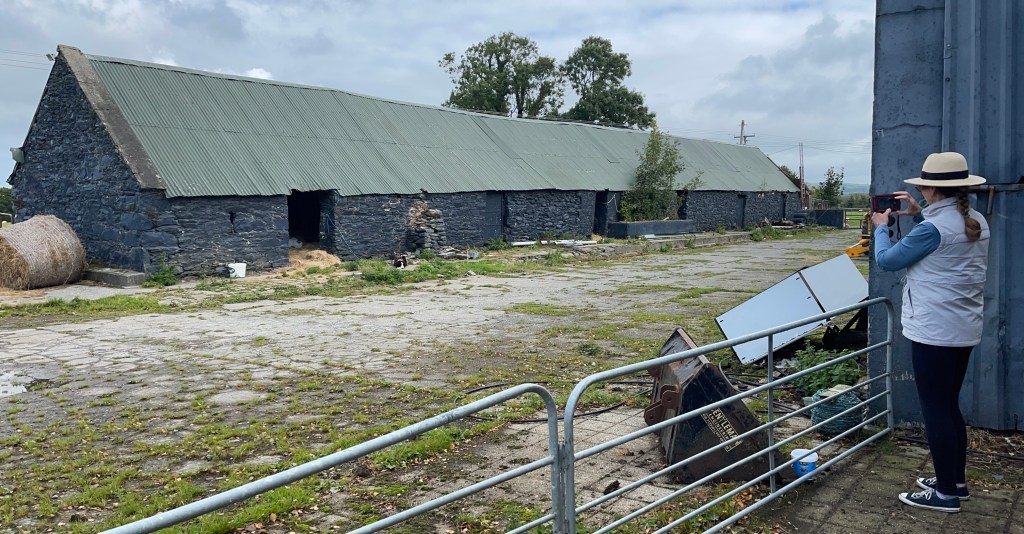
Our travels through Western Ireland — County Kerry and County Sligo, in particular — were genealogical searches. Kathleen and her brother Kevin, who joined Kathleen and me for most of our Ireland journey, were making contact for the first time in their lives with distant relatives on both their mother’s and father’s sides. This farm in Aghadoe/Nunstown is where their grandfather, John Cronin, grew up. They could not learn who was living there now. No one but a dog and a flock of sheep seemed to be at home when we stopped in.
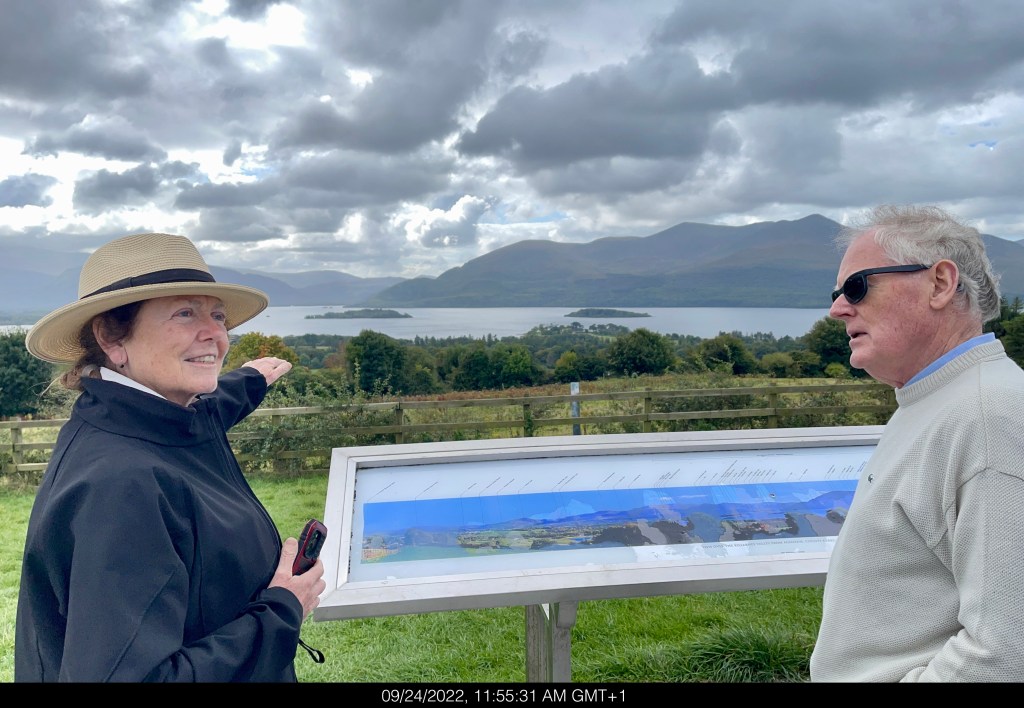
Kathleen and Maurice Daly, who is her cousin (3rd cousin, to be exact) and whom she had never met until a few days before this photo was taken (and knew nothing about until a few months before that) reflect on the splendor of a view across Lough Leane, to the McGillicuddy Reeks, Ireland’s highest mountains.
Near the parish of Glenbeigh, on the Iveragh Peninsula farther west in Kerry, something remarkable happened. Kathleen and Kevin knew that their maternal grandmother, Delia Sullivan, had left Glenbeigh at age 15, traveling alone to make a new life in America, where she would eventually meet and marry John Cronin. Delia moved out a few years after her father, John Sullivan, had died and after her mother had remarried and moved the family to a second home. Mossy, as Maurice is known, drove Kevin and Kathleen to Glenbeigh hoping to locate some remnant of their grandmother’s life. They stopped at a coffee shop and, on a whim, Maurice engaged a young woman working the check-out: Do you know any old-timers in town who could remember some of the families who lived here back when?
“My grandfather,” the woman said right off. Mossy wrote down the phone number, stepped outside the shop, and called him. The conversation yielded little, so Mossy and his charges drove off for the local cemetery to see what it could tell them. On the way they went down a wrong street and Mossy executed a U-turn using an adjacent driveway. Just as he began to back away, a man drove up who happened to live in that house. A conversation began. The man turned out to be the son-in-law of the cashier’s grandfather. He insisted now that Mossy call his father-in-law again, so Mossy did. The grandfather was hiking way up in the hills and he invited everyone to come up. No, that’s not going to happen, said Mossy, who nevertheless pressed on, asking the man if he knew of any other old-timer in the community. Yes, the grandfather said: Talk to John Barton.
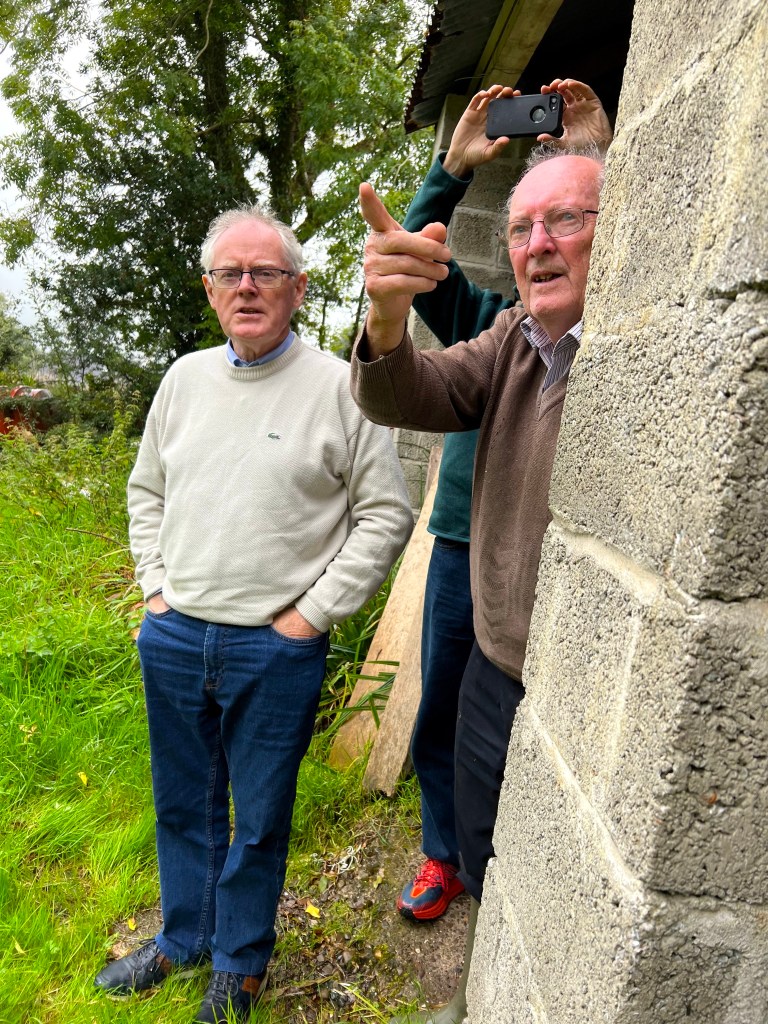
Maurice “Mossy” Daly, Kevin McCoy (unseen, w/ phone/camera) and John Barton, an old-timer from the area whom they had only just met, are shown near Glenbeigh on property to where Kevin’s grandmother, Delia Cronin, and her family moved after her mother remarried and not long before Delia emigrated alone to America. (Kathleen McCoy photo)
Armed with an address, Mossy and the others were soon sitting in the living room of John Barton and his wife, giving him the names and other information they had. Barton’s interest spiked. He told of a man named Sullivan who was known in these parts as “The Babe.” Now Kevin McCoy lit up: A distant relative had recently told him that his and Kathleen’s great-grandfather, John Sullivan, was known as The Babe. With this confirmation, Barton told them he knew exactly where John Sullivan and his family lived.
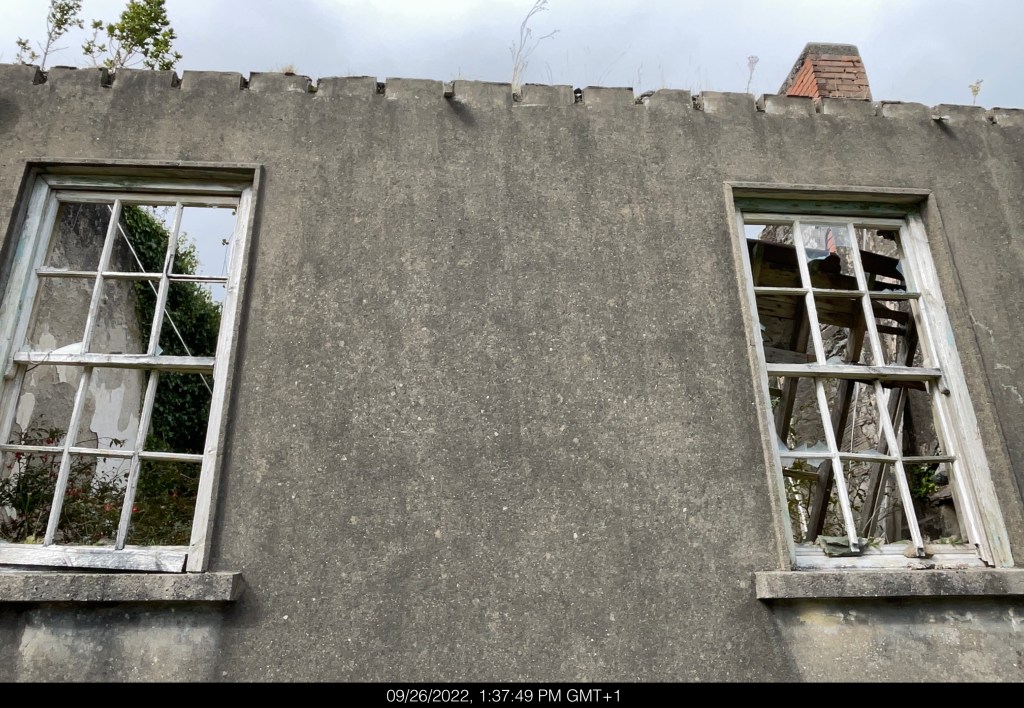
On a hillside commanding a view across a broad valley, they were soon gazing at the ruins of the Sullivan family home and, no more than 100 yards away along the same road, at the gender-segregated two-room schoolhouse Delia had attended, also in ruins. Dense vegetation had overtaken the fallen stone and concrete walls and grown through the empty doors and windows, and daylight poured through dilapidated roofs. Though it was all so far gone, what was left of the two buildings brought their meaning home for Kathleen and her brother, who had never expected to get so close to their own beginnings.
This building is what’s left of Delia Cronin’s schoolhouse near Glenbeigh. Her family’s first home is in no better condition, given over to the ever-encroaching vegetation.
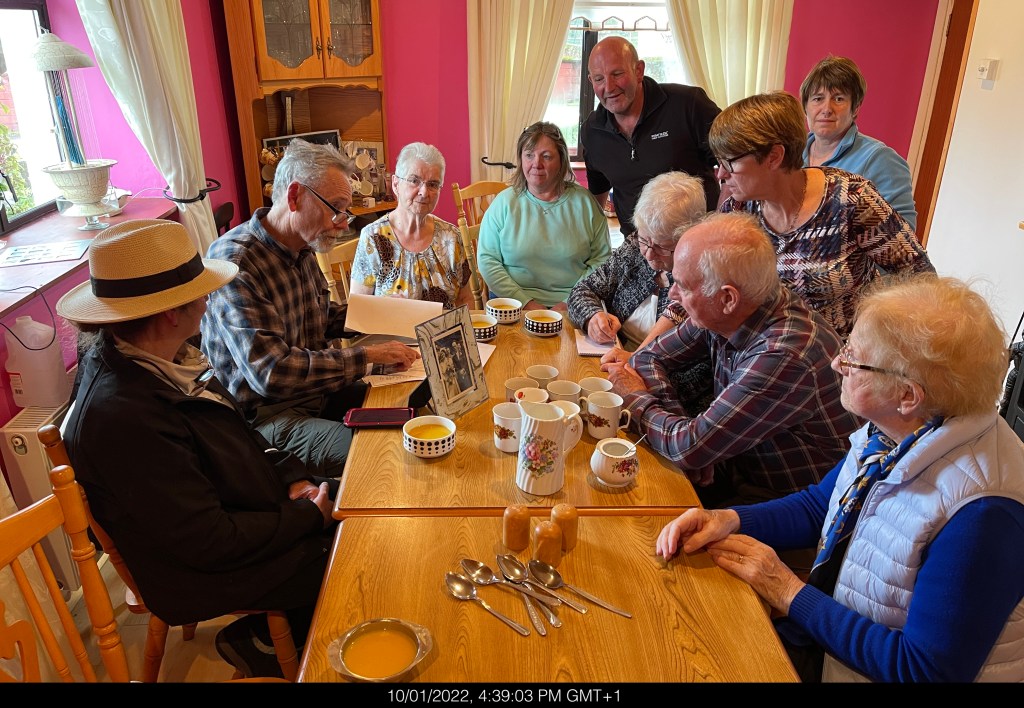
The story continued a week later, but on the other side of the family, that of Owen McCoy, Kathleen’s and Kevin’s father. Through his studies and with the help of Mossy’s research skills, Kevin had located and began communication with distant relatives of his grandfather, Owen’s father, in the village of Gurteen in County Sligo. By the time we arrived, the resident McCoys were waiting for Kevin to show up. As we drove down a hill approaching the house, the eldest, Gerry McCoy, was standing in the road waiting for us. After initial introductions, Gerry and several others — who began to arrive in ones and twos and seemingly did not stop coming — were sitting around a table enjoying tea, small sandwiches, homemade soup, cookies and Irish affability. Kevin produced his folder of family records and other documents and — his hands shaking with the emotion of the moment — told everybody what the papers showed: A few people long ago had picked up their lives in the old country and got themselves to Pennsylvania and New Jersey. They lived through times bad and good. Their descendants are still going strong way up in Alaska. And the people sitting around the table were connected to all of them.
Kevin McCoy explains to his newly encountered family members from the community of Gurteen, County Sligo, in northwest Ireland, the family relationships he has uncovered while doing genealogical research into his father’s Irish roots. Gerry McCoy, a distant cousin, sits opposite him.
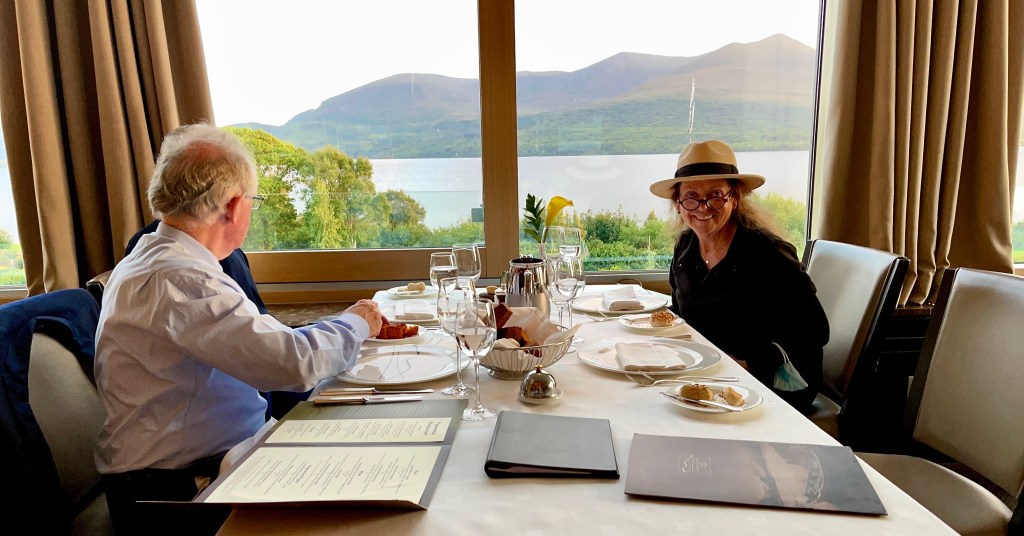
On September 24, towards the end of our first week in Ireland, we celebrated Kathleen’s 70th birthday with a fabulous dinner at the Panorama restaurant in the Hotel Europe outside the city of Killarney, County Kerry. Kathleen and I both had the Dingle Goat Cheese Ravioli, which was one of the most delicious restaurant dishes we’ve ever tasted. It came in a cheese “foam” with roast butternut squash, candied walnuts, pickled shallot, and crisp kale. Altogether four of us marked her birthday, including Kathleen’s brother, Kevin, and their Irish cousin Maurice, whom they met for the first time only 2 days earlier. At dinner we all 4 shared a bowl of buttered new potatoes (which were a creamy nirvana) and a bowl of mixed vegetables. The experience was off the charts. Out beyond the window is Lough (“Lake”) Leane.
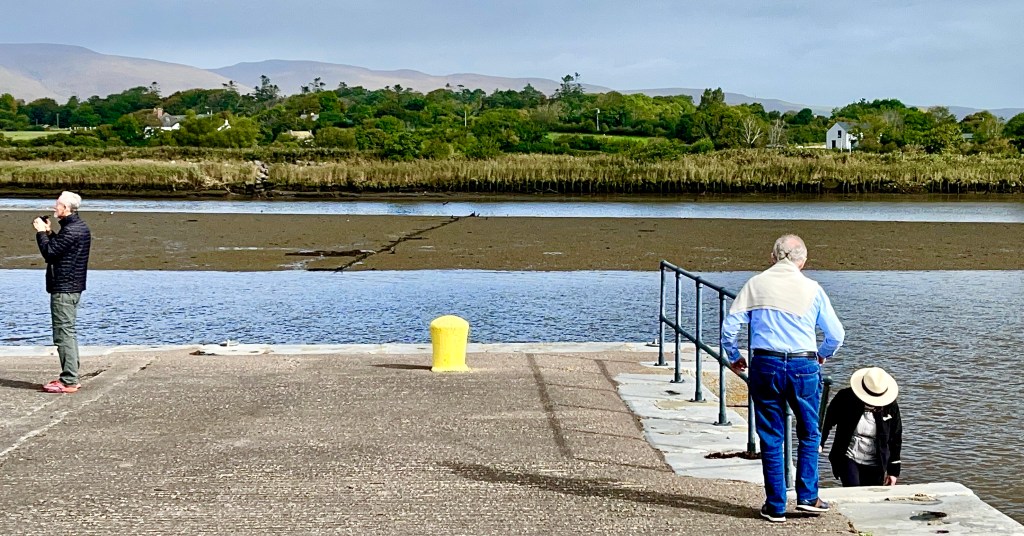
The plot was thick. A German ship, the Aud, carrying weapons intended for Irish revolutionaries, was headed for the west coast of Ireland on the night of Good Friday, 1916, awaiting a signal. Four members of the Irish Volunteers were driving through Killorglin in County Kerry that night on their way to Cahirciveen to seize the wireless station at Valentia Island. According to the Irish Times, they intended to transmit “a series of false signals which would fool the [British] Royal Navy into believing that a German attack on Scottish naval bases was imminent. It was hoped that such a move would allow the Aud … to proceed unmolested through Irish waters.” ¶ But the car’s driver took a wrong turn and drove down a road that ended at this pier at the River Laune. Under pains of poor visibility because the car lacked a headlamp, driver Tommy McInerney saw too late that the vehicle was headed for the water. In it plunged. McInerney survived, but the others drowned, the first casualties of the Easter 1916 Rising. The Aud’s skipper scuttled the ship and its weaponry went down with it. The Irish Revolution was stillborn that Spring, and the Irish were forced to wait several more years before winning independence. ¶ At Ballykissane Pier is a monument to the martyrs. When we were there, I felt that the real monument was this very pier, a concrete and stone structure that I doubt has changed much in 106 years.
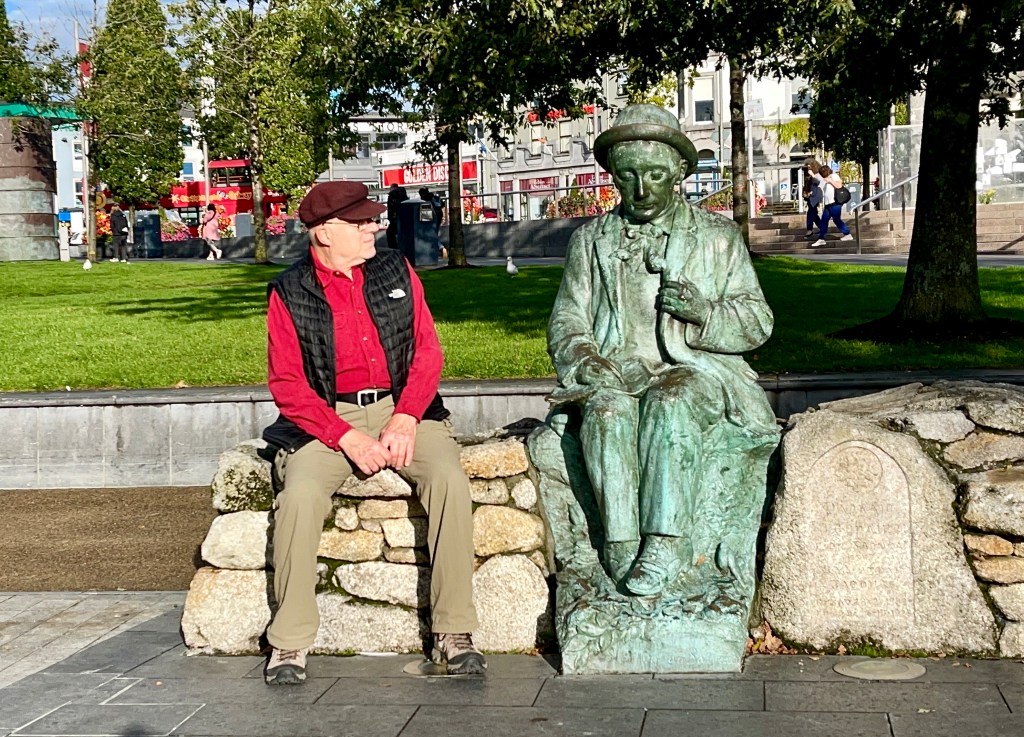
In late September I sat beside a statue of Irish poet Pádraic Ó Conaire in John F. Kennedy Memorial Park, Eyre Square, Galway. So much history and sadness seemed to come together in this image, in this park. JFK made a memorable journey through Ireland in June 1963, just 5 months before he was murdered. He gave a speech at this park attended by thousands (the Irish people loved it that one of their own had become the U.S. president). This statue of Pádraic Ó Conaire is a replica. The original is in the Galway City Museum where it was moved after vandals decapitated it in 1999. As I see it, this image of Ó Conaire, also known as Patrick O’Connor (he was a leader of the Irish language revival and wrote stories in Irish), shows him in a serious contemplation of sorrow, inspired by the book he’s reading. Not necessarily a sorrow regarding himself, but about the people he knew and wrote about it. Maybe that’s why the vandals attacked him: His inwardness, his ability to probe the sorrowful deep, to live with uncertainty, was too scary for the fools. Ó Conaire died in 1928 at about the age of 46.
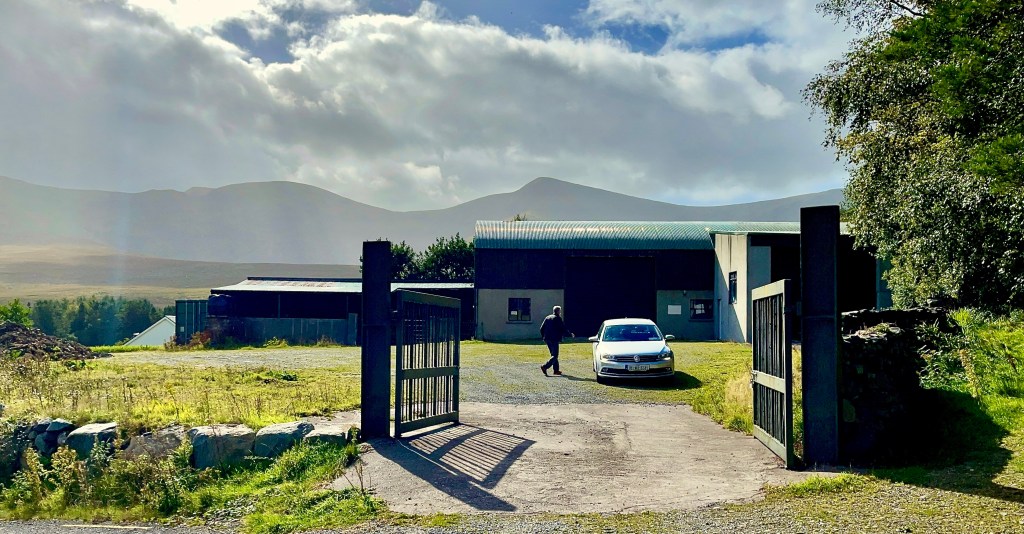
I can’t look at this photo without seeing a vista from somewhere out west in America. But it’s Ireland, near the town of Glenbeigh on the Iveragh peninsula, County Kerry. What I saw from inside our rented car and at those times when we stepped out into the towns or villages of west Ireland seemed no more developed than the American Southwest as I first saw it 43 years ago.
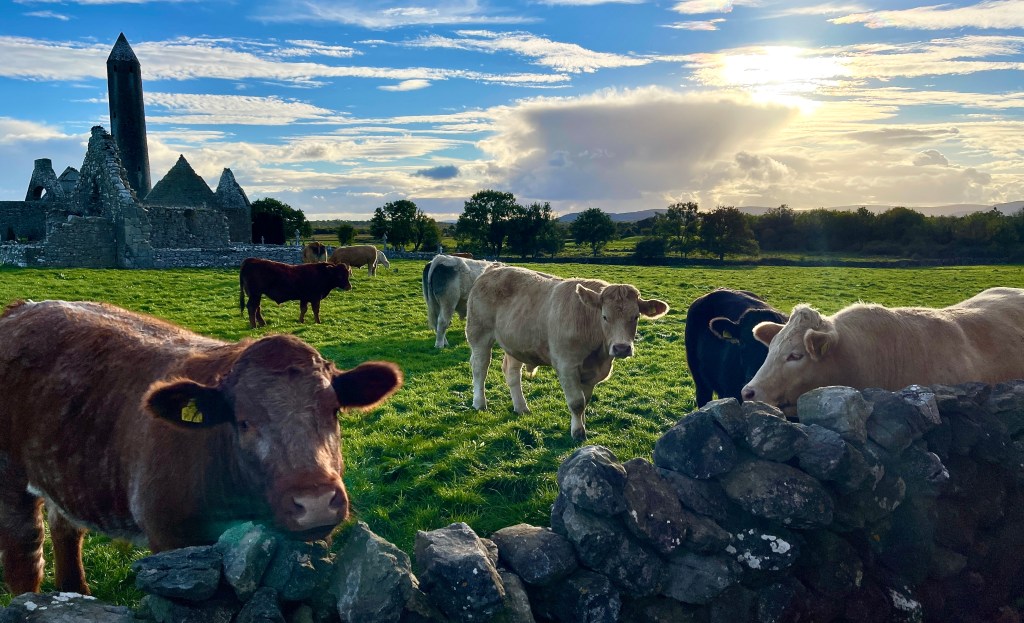
Stone walls, ruins of ancient stone buildings and cows (also sheep, horses & hedgerows) are everywhere in the countryside of west Ireland where we toured in September. We saw similar pastures during our drive from Sligo to Belfast, but it was in County Kerry, County Clare, County Galway, and County Sligo where we did most of our driving. ¶ The ruins in this photo are of the Kilmacduagh monastery in County Galway. According to on-site displays, the monastery was founded by St. Colman Mac Dutch early in the 7th century. The abbey is said to be one of the finest collections of monastic buildings in the country (there are more ruins than seen here). The churches were plundered in the 13th century but the site remained the Bishopric until the 16th century. The modern diocese still bears the name of the early monastery. ¶ The Round Tower seen in the background dates from around the 12th century. It functioned as a place of refuge for the monks in case of attack. ¶ The tower is actually a leaning tower: it tilts 2 feet from the perpendicular. For comparison, the taller Leaning Tower of Pisa leans 12 feet 10 inches from the vertical.
Which visitors to west Ireland do not visit the Cliffs of Moher? We were no different. The Cliffs may be Ireland’s most popular attraction. Their formation and strata make them a distant cousin to Arizona’s Grand Canyon, though they’re not nearly as high. Ancient river flow dropped sediments that, at the bottom of the cliffs, are more than 300 million years old. ¶ Visible out in the North Atlantic Ocean in this video are the Aran Islands, another tourist draw (which drew us one day), and beyond them a hint of the shores of Galway Bay. Note the cows, which (along w/ sheep) are impossible to avoid in Ireland.
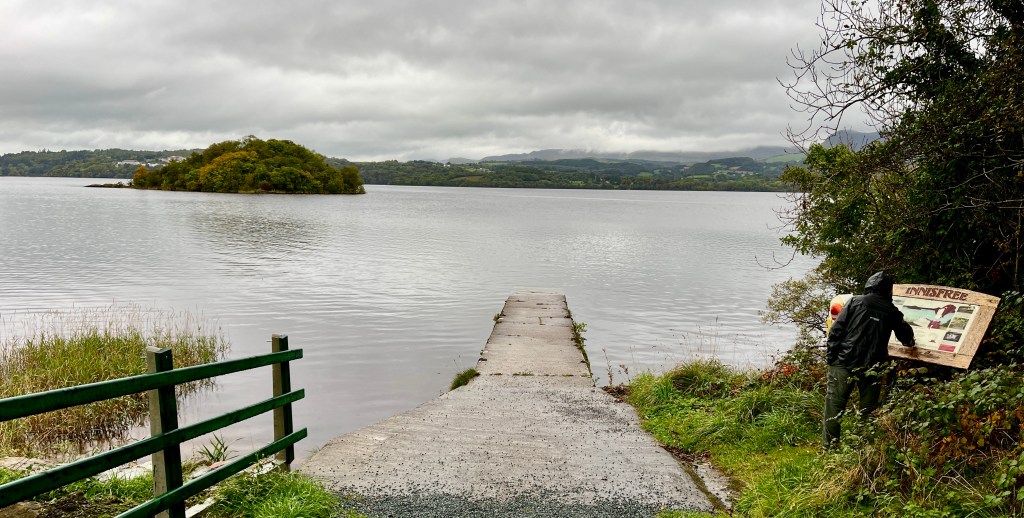
Lough Gill, not far from Sligo in County Sligo, Ireland, and the island Innisfree, written about in a famous poem by William Butler Yeats, who knew this country well.
Lough Gill is a freshwater lake near Sligo in west Ireland. The 5-mile-long lake, where people walk the nature trails through the surrounding woodlands, watch birds, and kayak on the water, is associated with a famous poem by the great Irish poet William Butler Yeats. The lake is not the focus of the poem. Instead, the poet draws our attention to a little island, the one you see here, whose name is Innisfree. Yeats wrote meditatively and symbolically about that island in a famous poem, “The Lake Isle of Innisfree.”
Yeats (1865-1939), who is buried in Drumcliff, 5 miles north of the town of Sligo, would spend summers in this region when he was a child and youth. If you travel through this country, as we did early this month, you’ll see a number of tributes to him, like the Yeats Country Hotel at Rosses Point, a little bit of land jutting into the sea where he and his family would vacation; a visually arresting statue of him (erected in 1989) in Sligo, a B&B named after him, and so on.
“The Lake Isle of Innisfree” was written in 1888 and first published in 1890.
<<<<<< >>>>>>
THE LAKE ISLE OF INNISFREE
by William Butler Yeats
I will arise and go now, and go to Innisfree,
And a small cabin build there, of clay and wattles made;
Nine bean-rows will I have there, a hive for the honey-bee,
And live alone in the bee-loud glade.
And I shall have some peace there, for peace comes dropping slow,
Dropping from the veils of the morning to where the cricket sings;
There midnight’s all a glimmer, and noon a purple glow,
And evening full of the linnet’s wings.
I will arise and go now, for always night and day
I hear lake water lapping with low sounds by the shore;
While I stand on the roadway, or on the pavements grey,
I hear it in the deep heart’s core.
<<<<<< >>>>>>
Yeats spoke about his inspiration for the poem in a moving and, for anyone interested in the creative process, fascinating way. The passage is almost as famous as the poem: “I had still the ambition,” he wrote, “formed in Sligo in my teens, of living in imitation of [Henry David] Thoreau on Innisfree, a little island in Lough Gill, and when walking through Fleet Street [in London] very homesick I heard a little tinkle of water and saw a fountain in a shop-window which balanced a little ball upon its jet, and began to remember lake water. From the sudden remembrance came my poem ‘Innisfree,’ my first lyric with anything in its rhythm of my own music.”
I first read Yeats’s poem in a course on modern poetry that I took in my final semester as an undergraduate a long time ago in The Bronx. The course was one of my most important learning experiences. I still have and still occasionally read my copy of the course text, Modern American and Modern British Poetry, an exhaustive anthology compiled by Louis Untermeyer and originally published in 1922 with later editions, including a revised, shorter edition published in 1955, which was the text we read. Until we began that course in mid-January 1969, I had never read anything by Yeats, T.S. Eliot, Ezra Pound, W.H. Auden, Wallace Stevens, Dylan Thomas, and other poets.
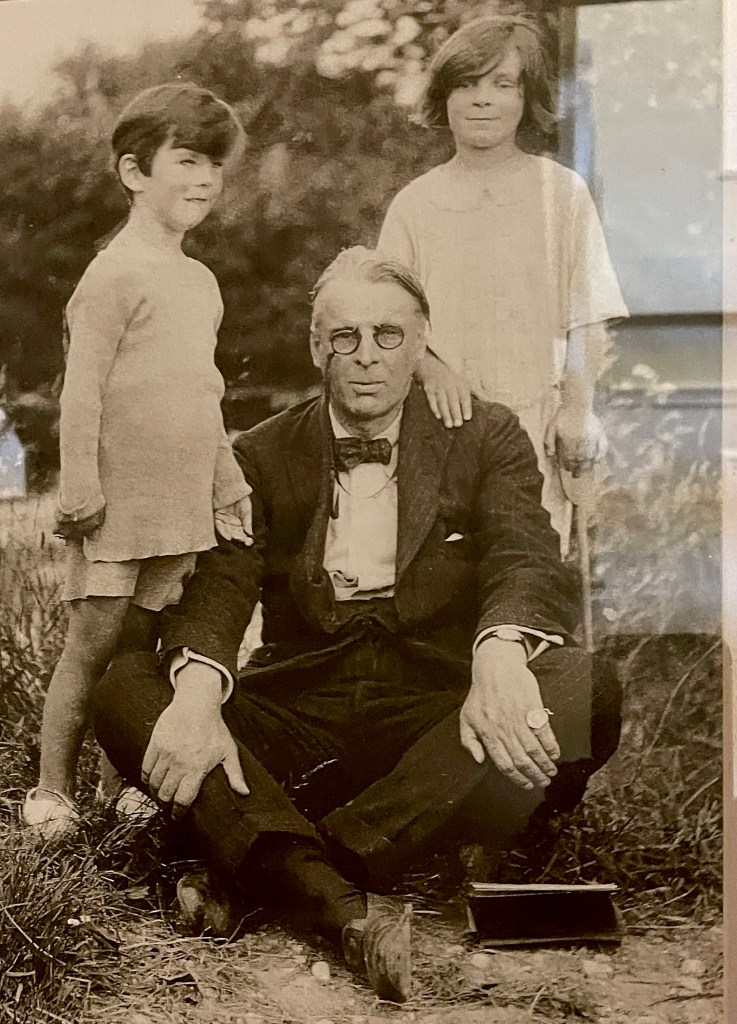
My photo is of a photograph displayed in the Yeats Country Hotel at Rosses Point, outside the town of Sligo, County Sligo, Ireland. (Names of children and date and place of photo unavailable.)
“The Lake Isle of Innisfree” was the first poem we read. After reading the poem aloud, our instructor, a classy Southerner with a tremendous passion for poetry and Shakespeare, opened the talk by placing Yeats’s poem into a broad cultural and political moment, the fin de siècle (“end of the century”). The term is often applied to the end of the 19th century and is taken to mean that Western culture (especially in France) was going through a period of lassitude, decadence, and decline. The professor pointed to the mood of the poem and in particular the first line: The speaker has been sitting or lying down and perhaps doing nothing more than thinking or dreaming, but nothing seriously worth mentioning. The poem doesn’t really start, doesn’t demand our attention, until he decides to get up and build his little Thoreauvian cabin, a refuge from the world, a place for solitude and contemplation but not for action in the social sense. He’ll be alone with the bees and the softly lapping water. He won’t engage with human institutions or his fellows.
How many people today feel exactly the same way as the poem’s speaker, who decides that the “bee-loud glade” and the song of the crickets and the “dropping slow” peace are all preferable to the ceaseless activity and madness of the cities and suburbs that we’re all trapped in? Many Alaskans, I’m sure, know exactly what I’m talking about.
By the way, I urge readers to listen to Yeats recite his own poem. I was much surprised when I first heard it. I never expected that Yeats’s “music” was so incantatory, although actually seeing his little island and knowing he was thinking about that place while walking around London makes me understand his poem more than I ever did.
I love older well-designed, romantic pubs and restaurants, places with a human scale that above all are comfortable to the body and mind and pleasing to the eye. We stumbled on such a place one afternoon in the Latin Quarter of Galway. I managed to take this (jumpy) video of its interior — make that interiors, because this is a decorative warren of rooms and sub-rooms and little alcoves, an adult playset. And despite my penchant for the old, it’s been this way only since 1997 (but it looks old style). It consists of Malone’s Whiskey Bar, The Front Door, and a back gin bar (name forgotten) — all in all, 6 bars (not all shown) and assorted other hideaways on several floors. The whole of it was developed out of the lower floors of 3 separate houses. I was told that when they began, they didn’t have a final vision of what it would look like, just built one room first and then poked a hole in a wall and started making another, and so on. This is the end result.
>>>> <<<<
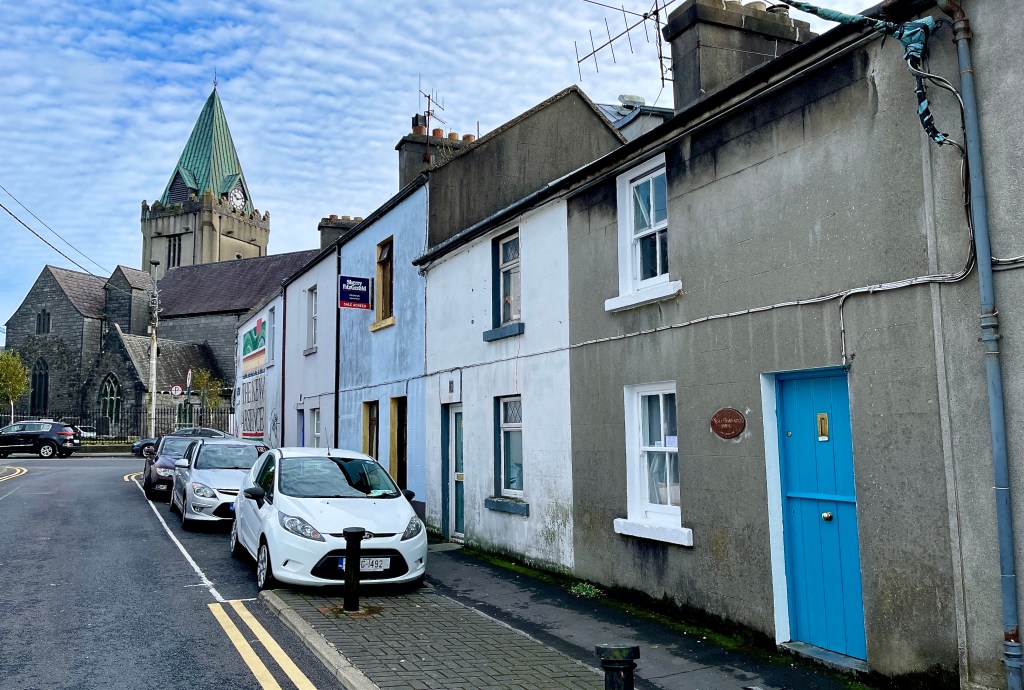
This street is Bowling Green in Galway. On the other side of St. Nicholas’s Church in the distance is The Latin Quarter. In the house on the right (with the oval plaque) there once lived one of the most famous muses in all literature: Nora Barnacle, who became the lover, mother of his two children and eventually wife of the Irish author James Joyce. Nora would move out of Galway to become a chambermaid in Dublin, which is where Joyce met her. To judge by the letters they wrote each other when they were apart for some time, Jim and Nora enjoyed as steamily erotic a relationship as any man & woman may enjoy. (I really do dare you to read those letters.) This house, which remained in Nora’s family for many years after she left, is exceptionally modest, perhaps even humble. ¶ Galway’s Latin Quarter is an exciting district of pubs, Irish music, restaurants, shops, etc. When we were there a few weeks ago (Sept. 27 to Oct. 1), I was struck by how the Irish girls and young women dressed to show a lot of skin, even though evening temperatures were in the 40s. And then I thought … How did Nora Barnacle (b. 1884) dress as a teenager and young adult in the late 19th and early 20th centuries? Ireland then was more repressive than it is today, so she was probably modest, well covered up. But maybe that’s why she moved to Dublin, the big Irish city. ¶ Joyce’s father, John Stanislaus Joyce, was a bit of a wit (a trait he passed on to his son). When he learned that Jim’s girl was named Barnacle, he quipped, “Well, she’ll never leave him.”

 picoalaska