Keeping the English Sober

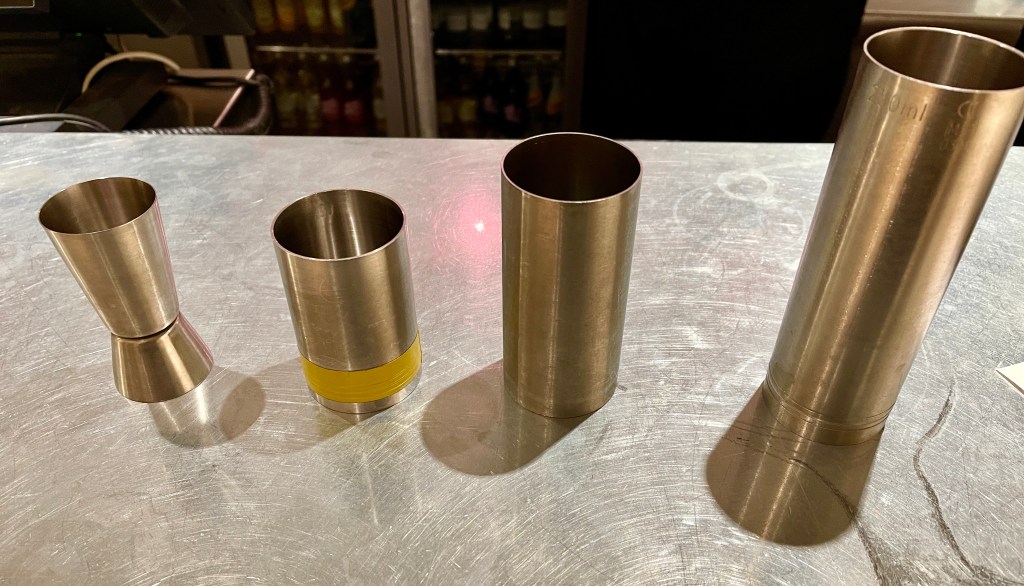
Measure for measure, the English people may be among the most disciplined drinkers on earth. Bartenders are required by law (and by their bosses and bar owners) to dispense certain types of alcoholic beverages in precise amounts, what the law calls “specified quantities,” when serving by the glass. So, for example, when you order still wine at the bar or at table, you’ll likely be offered a choice of small, medium or large. Those sizes correspond to 125 ml, 175 ml and 250 ml (roughly 4¼, 6 and 8½ fluid oz.). At a theatre bar where we recently drank, the barkeep would dole out those amounts in, respectively, the 2nd, 3rd and 4th measuring cups seen in the photo. The 1st cup is for measuring certain spirits — gin, rum, vodka & whiskey. With this end up, as seen in the photo, you can measure out 50 ml. (roughly 1¾ oz.), or what officially amounts to a double shot. Turn the cup over — as in the photo below — and you have the means to pour a single shot, 25 ml. ¶ I’m not certain, but I believe that Irish bars may have to dispense with their beverages under similar guidelines. I wondered, when we were in Ireland and later during our first travels through England, why the drinks uniformly seemed pallid. I seriously wondered, for example, if the gin was being watered down (the Negronis I ordered one evening at a wonderful oyster bar in Galway were frankly of no consequence whatever, and I departed an unhappy patron). But now I think I understand: When ordering certain cocktails, you’ll probably want to make it a double shot and, depending on your taste, budget and tolerance, perhaps order more than one.
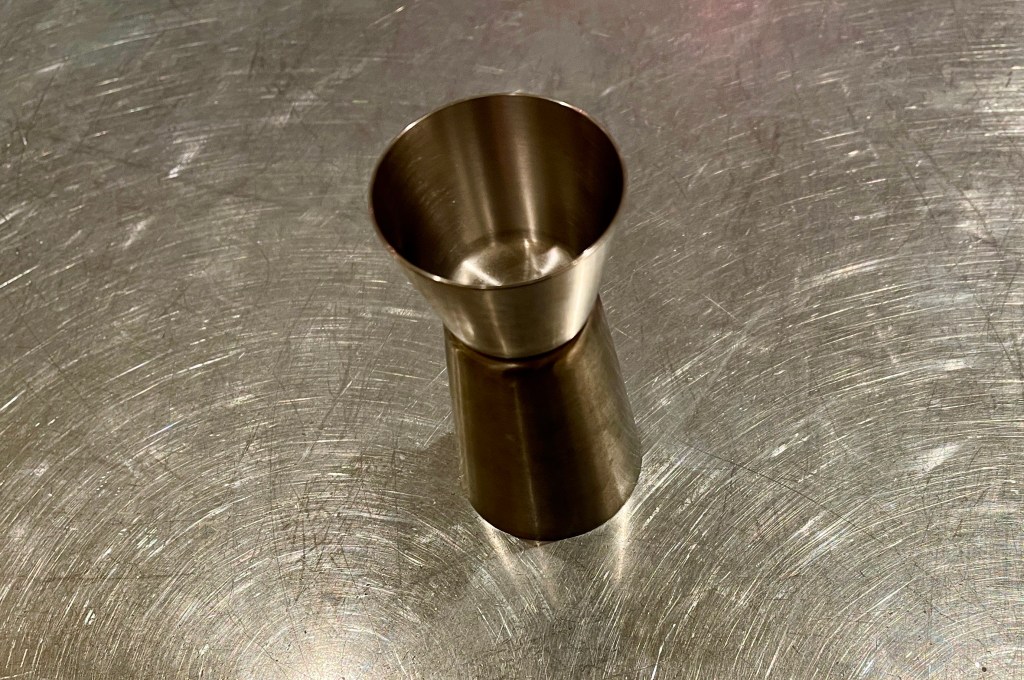
A cup for measuring out an exact shot of gin, rum, vodka or whiskey as defined by alcohol-beverage regulations in the U.K., according to a bartender in Cambridge, England. Turn the cup over and you can pour an exact double.

What about American bars & restaurants — what limitations determine the amounts they pour into wine and cocktail glasses? I have not researched this — that is, whether a certain set of regulations governs the quantity you’ll receive when ordering a drink in the States. But my experience tells me it’s entirely up to the bartender. If they’re friendly, if they like you, you’ll get a generous pour. Or buy that second glass of wine. I have often noticed that the second pour is larger than the first. Perhaps it’s a reward for opening your wallet a bit wider.
Pico Pub Crawl — The Eagle, Cambridge, England

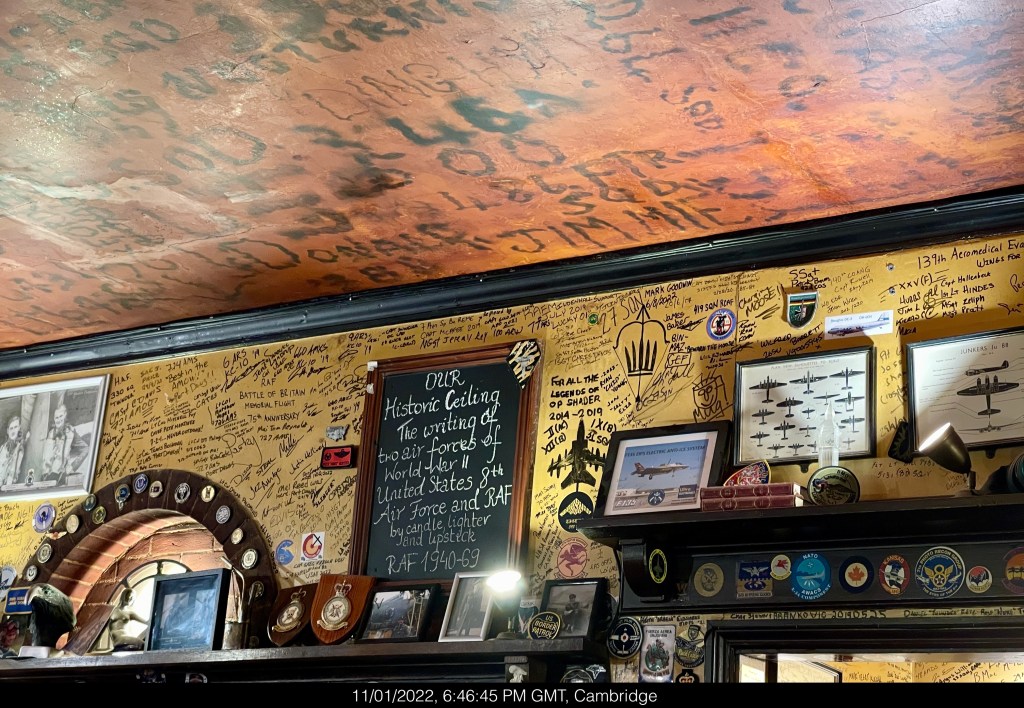
The writing is on the wall at The Eagle, probably the most famous pub in Cambridge, England, a city that just may have more pubs & restaurants per block than anywhere else in the sceptered isle. History is what gives The Eagle its cachet. It claims to date from as far back as 1667, although some sites place its beginnings in the middle ages. We stopped in for dinner and a pint the night we arrived in Cambridge to take in its considerable history. ¶ During WWII, British and American pilots and bomber crews stationed in this part of England (airmen of both nations during the war were quartered over much of Great Britain) would put aside their concerns and their rivalries and drink away an evening at The Eagle. While there, they scrawled their names, the names of their units, their planes, any numbers that meant something to them, on the ceiling. They used (as the sign you can see in the still photo says) candles and lipstick. ¶ Those scrawls remain today. The notation of important data and airmen’s names enjoys a long tradition at the Eagle, and it went on after the war. The walls here, as you will see in these images, are smothered with flyboy graffiti. ¶ Another story told by pub workers and patrons and reiterated in many other places is how, on the evening of February 28, 1953, molecular biologists Francis Crick and James Watson, who were researchers at Cambridge U. and who were said to frequent the Eagle six nights of every seven, stood up in an ale-infused euphoria to announce they’d found “the secret of life” — that is, they had discovered the double-helix structure of the DNA molecule. Some of this is probably an exaggeration. It appears more the case that on that evening Crick came to the pub where he and Watson were regulars to make the announcement to others in their circle. ¶ Another fact regarding the discovery of DNA that is less colorful and certainly less bruited is the part played by a woman scientist, Rosalind Franklin, in giving Watson & Crick invaluable information through her own experiments involving the shape of molecules.  She died some years before the two scientists (and a 3rd, Maurice Hugh Frederick Wilkins) won the 1962 Nobel Prize for their discovery.

Part of the ceiling and a wall in “the RAF bar,” one of the five bars at The Eagle, perhaps the most famous pub in Cambridge, England. (Pub’s floor plan in next photo.)
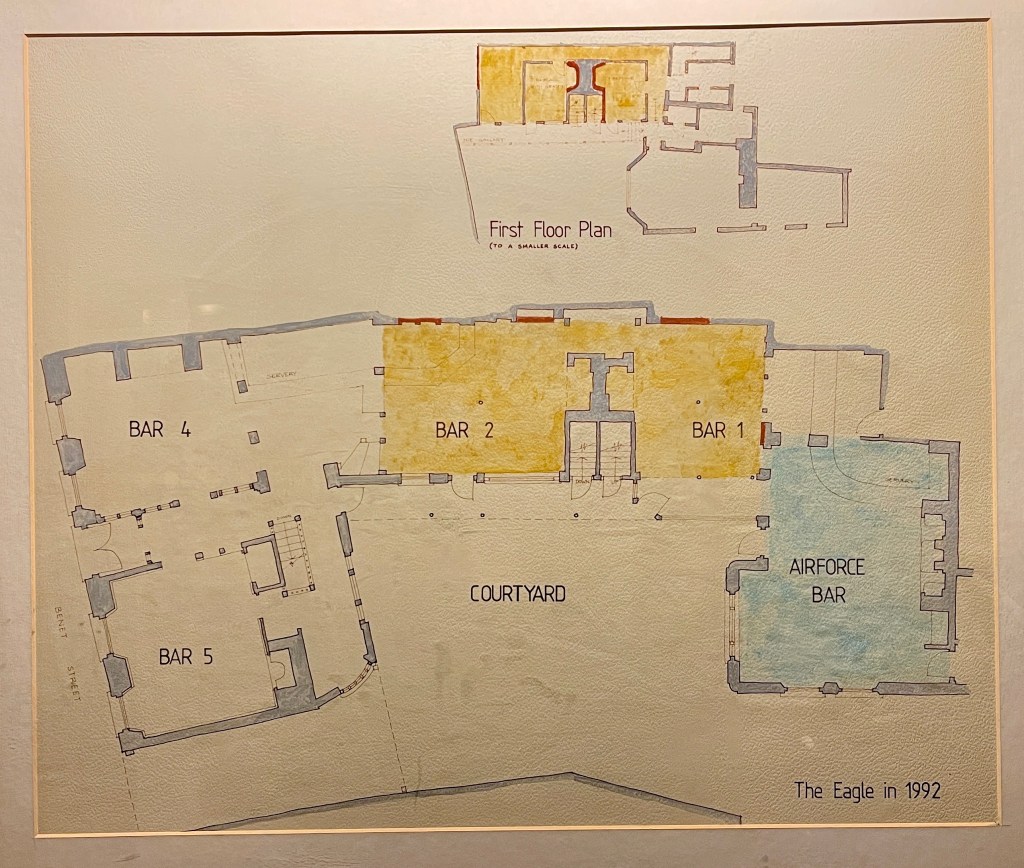
A 1992 drawing of The Eagle’s floor plan hangs on a passageway wall at the pub.

<<<<<<<< >>>>>>>>

This is my final “Pico Pub Crawl” for the reasons given in my previous post. But it’s not our final visit to old English pubs, which is among our favorite ways to burn time. On Sunday morning we leave for London. ¶ For those following our journey, we changed our plans and now will return to the States in late November. We had plans to visit Normandy and Paris after the U.K. and to end up with 10 days in Prague, but we’re approaching burnout. Also, we got sick. Kathleen and I each came down with a nasty bug as well as conjunctivitis (we tested negative for Covid). We appear to be mostly clear of it now but we’ve lost energy. Still, we’ll try to finish up in a big way — 12 days in London.

Pico Pub Crawl — The Turf Tavern, Oxford, England

This is a late October look at the The Turf, a famous hole-in-the-wall pub in Oxford, England, a town where the city is synonymous with the university. The Turf Tavern is ensconced in a hidden byway of what I think is one of the university’s colleges, or maybe nestled between two colleges. I’m not sure. But it’s such a meme to actually locate the pub that I saw T-shirts with a slogan something like “I found The Turf!” ¶ I have made these “pub crawl” videos for several reasons: a) because I love Irish and English pubs of strong and distinctive character, a look & feel that have carried forward, in some cases, for centuries; b) because eating & drinking at these establishments is a pleasureable and relatively inexpensive way to get our calories, and so they’ve become a necessary and enjoyable part of this journey, thus part of what I’m showing through this blog; c) because part of living in Anchorage, Alaska, is to know I’ll never see anything like this there, so I’m having the experience of patronizing such a place more than once — many times more than once if I can stand to look at these videos again. ¶ Which brings up a problem with them: Those who’ve looked at the two I’ve posted so far and now at a third will notice that they’re repetitive. People — workers and patrons — are certainly active but they don’t have an unlimited repertoire of activities. So the charm is wearing off. You can do only so much with a camera held at your belt buckle as you walk about a well-occupied venue without trying to attract attention. Therefore, the next “pub crawl” video I post will be the last, at least until I find something new to do with them. But the next one will be a nearly 2-minute glimpse through an absolutely fantastic pub, with a fantastic history.

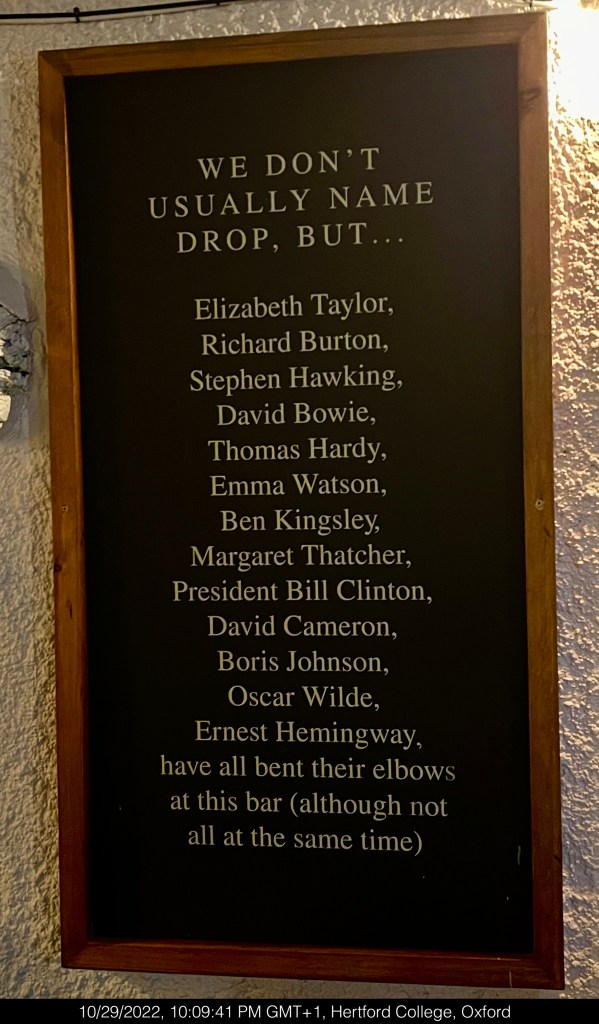
This board hangs along one of The Turf’s passageways & outdoor eating alcoves.

Pico Pub Crawl — The Celt, Dublin

This is the inside of a Dublin pub called The Celt, shown on a Sunday evening in early October. (The first pub in which I walked around w/ my phone/camera leading the way is The Front Door in Galway City.) The Celt is located on Talbot Street in a district north of the River Liffey. Talbot needs some introduction. Although it is a calm and fairly dignified commercial and residential street today, it’s said to have been a boundary of the infamous Monto, Dublin’s red-light district and the largest in Europe during its 19th-20th-century prime. British soldiers were the johns in many cases, so when Ireland won its independence from Britiain in 1921 and set up the Irish Free State in 1922 (that is, for all but the six counties of Ulster Province in the north), the soldiers went home and the chief industry of the Monto district declined. ¶ But when it was going strong, it was notorious for disease and filth and poverty. In James Joyce’s novel “UIysses,” the two protagonists, Leopold Bloom and Stephen Daedalus, visit a brothel in the Monto, but that whorehouse is nowhere as shabby as the more typical brothel apparently was. ¶ We visted the Celt more than once. The energy to be seen in this brief video is mild compared with how electric the place can be. ¶ The second video in this post (below) gives a sample of the live music heard every night.