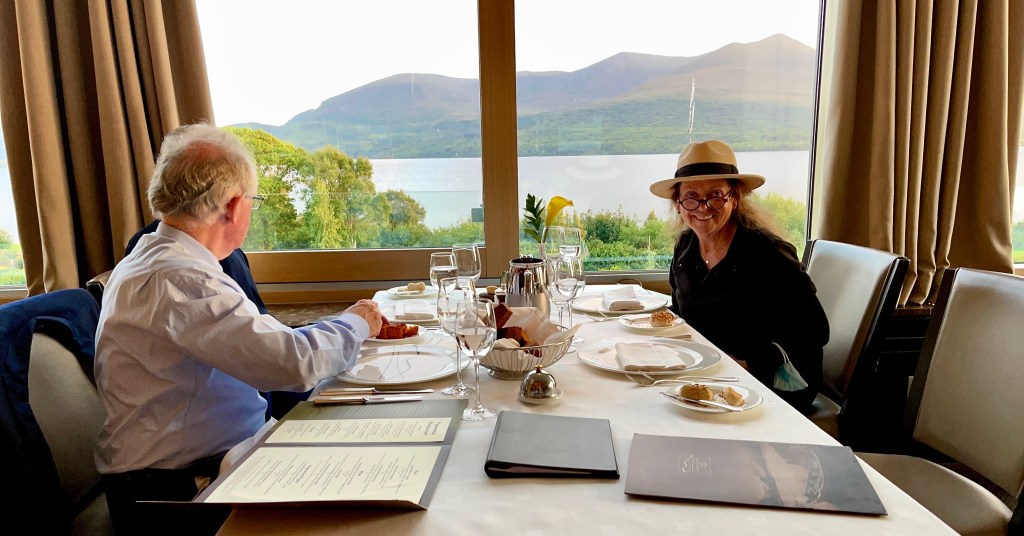
On September 24, towards the end of our first week in Ireland, we celebrated Kathleen’s 70th birthday with a fabulous dinner at the Panorama restaurant in the Hotel Europe outside the city of Killarney, County Kerry. Kathleen and I both had the Dingle Goat Cheese Ravioli, which was one of the most delicious restaurant dishes we’ve ever tasted. It came in a cheese “foam” with roast butternut squash, candied walnuts, pickled shallot, and crisp kale. Altogether four of us marked her birthday, including Kathleen’s brother, Kevin, and their Irish cousin Maurice, whom they met for the first time only 2 days earlier. At dinner we all 4 shared a bowl of buttered new potatoes (which were a creamy nirvana) and a bowl of mixed vegetables. The experience was off the charts. Out beyond the window is Lough (“Lake”) Leane.
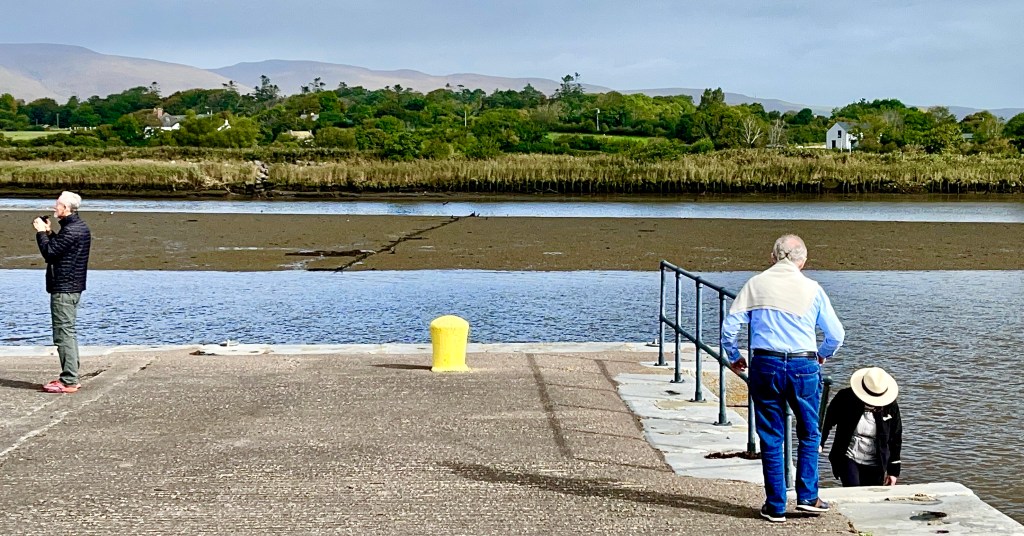
The plot was thick. A German ship, the Aud, carrying weapons intended for Irish revolutionaries, was headed for the west coast of Ireland on the night of Good Friday, 1916, awaiting a signal. Four members of the Irish Volunteers were driving through Killorglin in County Kerry that night on their way to Cahirciveen to seize the wireless station at Valentia Island. According to the Irish Times, they intended to transmit “a series of false signals which would fool the [British] Royal Navy into believing that a German attack on Scottish naval bases was imminent. It was hoped that such a move would allow the Aud … to proceed unmolested through Irish waters.” ¶ But the car’s driver took a wrong turn and drove down a road that ended at this pier at the River Laune. Under pains of poor visibility because the car lacked a headlamp, driver Tommy McInerney saw too late that the vehicle was headed for the water. In it plunged. McInerney survived, but the others drowned, the first casualties of the Easter 1916 Rising. The Aud’s skipper scuttled the ship and its weaponry went down with it. The Irish Revolution was stillborn that Spring, and the Irish were forced to wait several more years before winning independence. ¶ At Ballykissane Pier is a monument to the martyrs. When we were there, I felt that the real monument was this very pier, a concrete and stone structure that I doubt has changed much in 106 years.
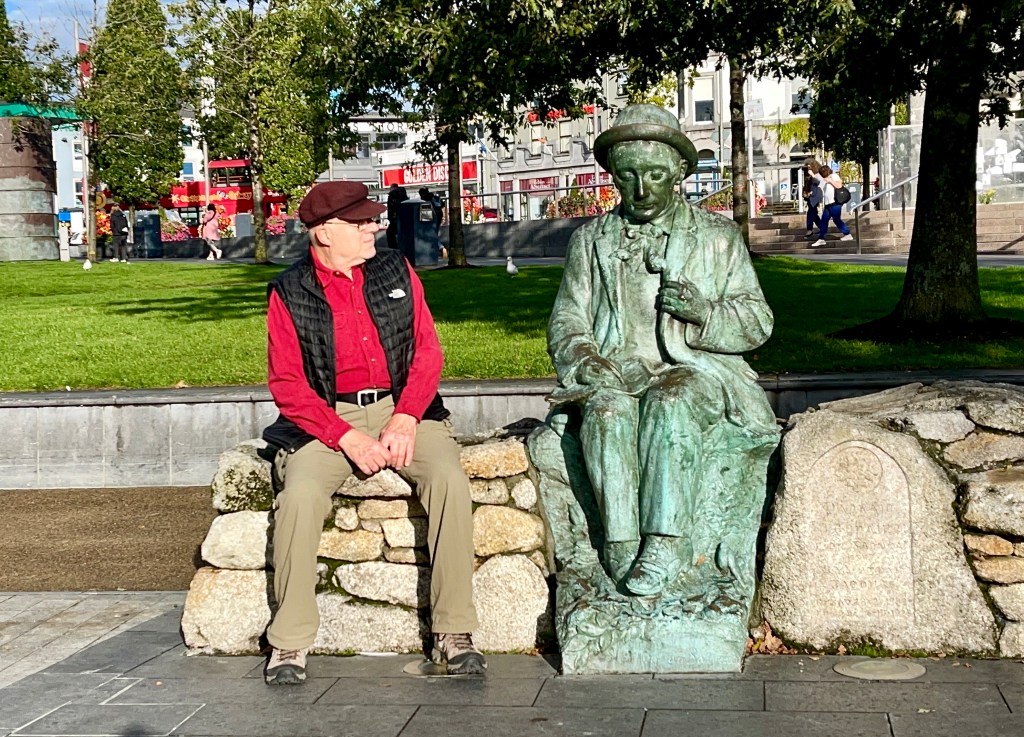
In late September I sat beside a statue of Irish poet Pádraic Ó Conaire in John F. Kennedy Memorial Park, Eyre Square, Galway. So much history and sadness seemed to come together in this image, in this park. JFK made a memorable journey through Ireland in June 1963, just 5 months before he was murdered. He gave a speech at this park attended by thousands (the Irish people loved it that one of their own had become the U.S. president). This statue of Pádraic Ó Conaire is a replica. The original is in the Galway City Museum where it was moved after vandals decapitated it in 1999. As I see it, this image of Ó Conaire, also known as Patrick O’Connor (he was a leader of the Irish language revival and wrote stories in Irish), shows him in a serious contemplation of sorrow, inspired by the book he’s reading. Not necessarily a sorrow regarding himself, but about the people he knew and wrote about it. Maybe that’s why the vandals attacked him: His inwardness, his ability to probe the sorrowful deep, to live with uncertainty, was too scary for the fools. Ó Conaire died in 1928 at about the age of 46.
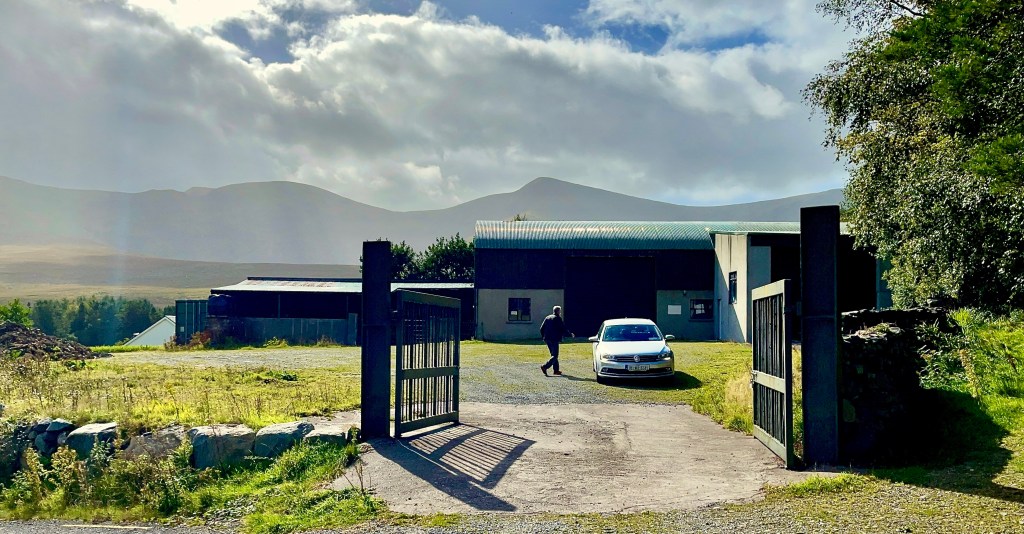
I can’t look at this photo without seeing a vista from somewhere out west in America. But it’s Ireland, near the town of Glenbeigh on the Iveragh peninsula, County Kerry. What I saw from inside our rented car and at those times when we stepped out into the towns or villages of west Ireland seemed no more developed than the American Southwest as I first saw it 43 years ago.
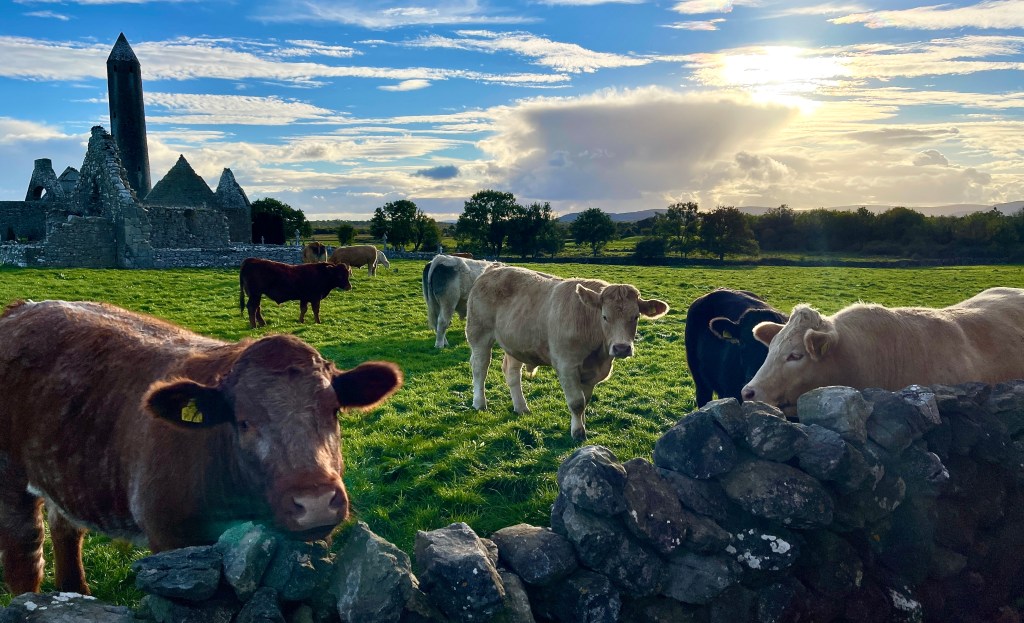
Stone walls, ruins of ancient stone buildings and cows (also sheep, horses & hedgerows) are everywhere in the countryside of west Ireland where we toured in September. We saw similar pastures during our drive from Sligo to Belfast, but it was in County Kerry, County Clare, County Galway, and County Sligo where we did most of our driving. ¶ The ruins in this photo are of the Kilmacduagh monastery in County Galway. According to on-site displays, the monastery was founded by St. Colman Mac Dutch early in the 7th century. The abbey is said to be one of the finest collections of monastic buildings in the country (there are more ruins than seen here). The churches were plundered in the 13th century but the site remained the Bishopric until the 16th century. The modern diocese still bears the name of the early monastery. ¶ The Round Tower seen in the background dates from around the 12th century. It functioned as a place of refuge for the monks in case of attack. ¶ The tower is actually a leaning tower: it tilts 2 feet from the perpendicular. For comparison, the taller Leaning Tower of Pisa leans 12 feet 10 inches from the vertical.
Which visitors to west Ireland do not visit the Cliffs of Moher? We were no different. The Cliffs may be Ireland’s most popular attraction. Their formation and strata make them a distant cousin to Arizona’s Grand Canyon, though they’re not nearly as high. Ancient river flow dropped sediments that, at the bottom of the cliffs, are more than 300 million years old. ¶ Visible out in the North Atlantic Ocean in this video are the Aran Islands, another tourist draw (which drew us one day), and beyond them a hint of the shores of Galway Bay. Note the cows, which (along w/ sheep) are impossible to avoid in Ireland.

 picoalaska