This is a new blog. I’m starting it to keep my friends & family up to date on three months of travels through Ireland, the U.K., France and Czechia (the Czech Republic). I say “up to date,” but I’m posting this on October 12, already more than three weeks into our journey. So, sort of like space-time, my timeline curves, due to the pull of gravitational laziness.
And technological under-performance. Regarding this software, the WordPress system of creating & maintaining blogs or websites or both, I’m a full-on newbie. Therefore I also face an enormous learning curve, which bends toward irregularity as I grope along trying to catch up. My initial hope for these posts, for example, imagined they would appear as we carried on and things occurred, more or less chronological with the events they recorded. That’s not going to happen. The fact that I actually managed a first posting is providential. As of this writing we are less than 40 hours from leaving Dublin for Liverpool, where I expect our experiences to spike in excitement. It would be nice if I was conversant with the rudiments of WordPress by then. Which means that events of the past three weeks, if worthy of a narrative, will appear when they appear.
All right, let’s get started.
We left Anchorage on September 18. After 26 hours of travel, door to door, we settled into our downtown Dublin hotel room, exhausted and worried over how long it would take before we could feel we had something to look forward to instead of dragging our asses for a week or more. But the next morning (Sept. 20), after a night of inadequate sleep, we went down to the hotel dining room and were jolted deliriously awake by a magnificent buffet breakfast. The abundance and range of food choices and its quality amounted to a fanfare announcing that we were on vacation and off to a good start. (For those who are curious, we were staying at Jurys Inn Dublin Parnell Street, part of a chain and a good and not too expensive hotel very well located.)
Soon we were walking south through sunny Dublin streets. We crossed the Liffey River, wound our way past a corner of the Trinity College campus, past the statue of Molly Malone and her disappearing neckline, and ended up at a pub and entertainment venue called the International Bar. At every street crossing we explicitly reminded ourselves to look right for oncoming left-side-of-the-road traffic. It’s one thing to sit inside a car moving around a comparatively quiescent town like Anchorage and another when, only two days later, unsteady because of a 9-timezone lag, you’re walking through crowds and crossing busy streets in a heavily motorized city like Dublin. We would later return to Dublin after exploring other parts of Ireland and Belfast, yet still we lack any real confidence on these streets. The other day I thought it was clear to cross a sharply curving single-lane roadway at an expansive intersection, but halfway across I had to scamper like a terrorized animal because of a huge onrushing bus whose driver apparently wanted to kill me.
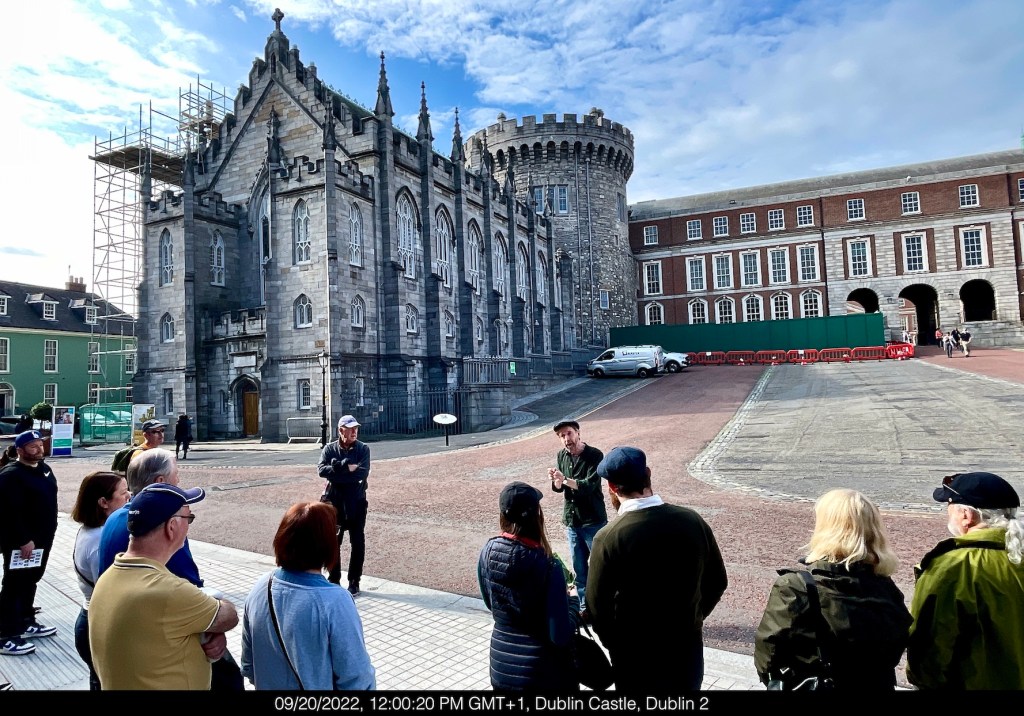
The International Bar is a comedy club. Kathleen and I and some 15 others were there to meet an actor and amateur historian who calls himself Jack. He would lead our group to major sites associated with the 1916 Rebellion, as the tour is named. The locations — Dublin Castle, the General Post Office, and others — are places where Irish revolutionaries instigated a violent uprising against their United Kingdom overlords (they chose Easter Week to set off their bombs and engage street battles with British soldiers and Irish constabularies due to the Easter “rising” of Jesus in the Christian iconography). No need here to recount the history of the next half-dozen years of violence and civil war that gave rise to a new nation, the Republic of Ireland (which notoriously did not include six counties of Ulster province — Northern Ireland). That history is available in many places online. However, this saga of the Irish independence movement dogged our travels throughout the island, including our visit to Belfast in Northern Island. It’s inescapable. Only a few hours ago, for instance, we toured Kilmainham Gaol (Jail) a few miles to the southwest of the city center, which is a site bitterly linked with the rebellion. So I hope to bring forward still more bits about our experience related to the events that a century ago gave Ireland its independence after 700 years of British rule.
Historical and other walking tours like The 1916 Rebellion have become a habit of Kathleen’s and mine. They’re an easy way to acquire a reasonably full picture of how specific locations fit into the larger narrative of important events. We’ve taken tours of sites linked to the birth of the Nazi Party in Munich, the concentration camps of Dachau and Buchenwald, World War 2 events in Prague and Paris, the Battle of Gettysburg, and key Spanish Civil War sites in Barcelona and Madrid. The tour leaders are generally knowledgeable authors, students or, like Jack in Dublin, artists with a passion for history.
So on that first day we quickly stepped into the role of inquisitive tourists getting our lick of Irish history, which was delivered exceptionally well. Jack is a slight, middle-aged Irishman, serious and talented. Occasionally he sang an Irish folk ballad to enhance the lesson. It became obvious he doesn’t think well of the English. When the recent death of the queen came up, he shrugged without sympathy.


Peter, goddammit, wish I could be there too! Looking forward to more reports and stories!
LikeLiked by 1 person
I’m so happy for you both. And, I think your writing is PURE GENIUS. I LOVE your blog. BE safe and happy travels. Love you both.
LikeLike
I need an agent. You up for it, Cuz?
LikeLike
LOL Would love it.
LikeLiked by 1 person
Happy blogging, Peter and Kathleen! And safe travels! Love your itinerary. Love the historical walking tours. I’m envious already.
LikeLiked by 1 person
Happy blogging, Peter and Kathleen! And safe travels! Love your itinerary. Love the historical walking tours. I’m envious already.
LikeLiked by 1 person
Dublin looks/feels/sounds fascinating. This is an ancestral home of my (paternal) family–the Barnwells.The Barnewall family has its roots deep in the soup of myth and legend that is the genealogy of medieval Britain and Ireland. It is said that ‘Le Sieur de Barneville’ hailed from Brittany and was one of the companions of William the Conqueror when he invaded England in 1066, but neither this name nor its many variants (de Barneville; de Barneval, Barnewill, Barnwell etc) seem to occur in Domesday Book. Drimnagh Castle in Dublin was a Barnewall castle.
LikeLike
That’s a hell of a pedigree, on both sides of the Irish Sea, and also of the English Channel. I read recently that the Normans originated from the “north” lands, or Scandinavia. In other words, they were Vikings too. They adapted well, however, to the lands they occupied, taking on the culture of the subdued peoples. By the time William gets around to conquering the English, he’s French. … You would love Dublin. You would also love Liverpool, where we are right now.
LikeLike